
The Return of the Sister Outsider(s)
Multidisciplinary art project
variable dimension
2026
Art District P, Busan, Korea
variable dimension
2026
Art District P, Busan, Korea
다원예술프로젝트
가변 크기
2026
예술지구P, 부산, 한국

<The Return of the Sister Outsider(s)>, 2026
Art Distric P
supported by Busan Cultural Foundation
Art Distric P
supported by Busan Cultural Foundation
<외인자매 : 귀환편>, 2026
예술지구 P
부산문화재단, 부산광역시 지원
예술지구 P
부산문화재단, 부산광역시 지원
“ The father is a king
The woman is born the seventh daughter
Because she is a daughter,the father and mother abandon her
The woman livesin the house of an old woman and an old manwho live in a pit
The woman has no name to the very end
The woman's name is simply “the abandoned child”
Word comesthat the father is dying of an incurable disease
Soldiers come and find the woman
They tell her to bring backthe water of life that will save the father
A place the happy and the preciouscannot enter
A place one must die to reach
The woman wanders through the world of the dead
The woman marries in deathThe woman gives birth in death
Three years of water
Three years of fire
Three years of wood
The woman lives through death
The woman finds water and flowers
With that water and those flowersthe father's illness is cured
The father offers the woman half his kingdomThe woman refuses
The woman becomes the one who ferries the dead across the river of death
— Kim Hye-soon,“Plot of Bari-degi,” from <Women, Poetry-ing>
------
Modern society demands that individuals possess a clearly defined identity and respond without delay. The ability to continually explain and prove oneself, to respond immediately to social expectations, has come to function as a measure of normality. Within this structure, those who lack a fixed identity or refuse to respond on demand are often pushed to the margins and classified as outsiders.
<The Return of the Sister Outsider> does not regard the position of the outsider as a condition of deficiency or failure. Rather, it understands outsiderness as a place of perception from which the order of the centre can be seen differently—a liminal position from which new possibilities may emerge. This figure of the outsider resonates deeply with Bari-degi, a figure from Korean shamanic mythology. Cast out as an unwanted daughter, Bari-degi exists beyond the centre of her community. Yet it is precisely from this position that she crosses the boundary between life and death, becoming a mediator between two worlds. She belongs entirely to neither. She is a being in perpetual passage across boundaries. Sister Outsider: The Return revisits this structure of passage through contemporary bodily practice.
Throughout history, women's bodies have been repeatedly defined and excluded within patriarchal systems. They have been inscribed as bodies of purity and sacrifice, as bodies that accommodate the desires of others, and as instruments for maintaining social norms. Yet the pain accumulated through these histories has never simply disappeared. It persists as embodied memory, carried across generations and deeply inscribed in our bodies.
Rather than seeking to eliminate this embodied memory, <The Return of the Sister Outsider> approaches it as an experience to be passed through. Through artistic practice, these memories are summoned back into the body. Climbing a pole becomes an act of passing through a vertical structure—one that evokes power and hierarchy. The body that hangs, rotates and endures is no longer a body to be consumed or objectified, but one that bears its own weight and reconfigures its relationship to gravity. Just as a shaman, standing upon blades, passes through pain to enter an altered state of being, the bodies of the Sister Outsiders do not evade pain but move through it, generating new points of sensory awareness. In this process, the body reclaims a position from which it was once excluded, opens up the possibility of reconfiguring the centre, and discovers new ways of being beyond established boundaries.
Through years of site-specific installation practice, I have explored the formation, disappearance and distortion of memory through structures, light and organic materials. My current inquiry turns towards pain: perhaps the most difficult form of memory to confront when it is inscribed in the body. Pain is not merely a psychological emotion, but an embodied memory accumulated within the body. The more it is suppressed, the deeper it seeps into the unconscious, reshaping our perception and our ways of sensing the world. This inquiry extends into writing with the body, in which the body becomes a medium that records experience and holds memory. Tensions, breath, movement and the traces left by wounds form a narrative of their own. Through the body, we read and interpret the world anew.
<The Return of the Sister Outsider> develops this inquiry into embodied memory and the structure of the Bari-degi myth into a multidisciplinary project bringing together installation, dance, performance and mask-making. The comic and subversive worldview of Korean mask traditions, alongside the breath and movement of Korean dance, serves as a central methodology. Through these practices, the project confronts the contradictions and absurdities of human existence while exploring how they might be endured, transformed and carried into another state of being.
At its core, <The Return of the Sister Outsider> begins with two questions:
How might we pass through accumulated pain and enter a different state of sensory awareness? And what kind of body do we become in that moment of passage?
Bari, who remains nameless to the very end, returns as a Sister Outsider who chooses, on her own terms, not to prove her existence.
<The Return of the Sister Outsider> is an ongoing artistic inquiry into the embodied memories of those who inhabit the margins, explored through bodily practice and spatial interventions. Through the body that passes through pain, the project seeks possibilities for other ways of sensing and being in the contemporary world.
May she return to all those who journey alongside her.
The woman is born the seventh daughter
Because she is a daughter,the father and mother abandon her
The woman livesin the house of an old woman and an old manwho live in a pit
The woman has no name to the very end
The woman's name is simply “the abandoned child”
Word comesthat the father is dying of an incurable disease
Soldiers come and find the woman
They tell her to bring backthe water of life that will save the father
A place the happy and the preciouscannot enter
A place one must die to reach
The woman wanders through the world of the dead
The woman marries in deathThe woman gives birth in death
Three years of water
Three years of fire
Three years of wood
The woman lives through death
The woman finds water and flowers
With that water and those flowersthe father's illness is cured
The father offers the woman half his kingdomThe woman refuses
The woman becomes the one who ferries the dead across the river of death
— Kim Hye-soon,“Plot of Bari-degi,” from <Women, Poetry-ing>
------
Modern society demands that individuals possess a clearly defined identity and respond without delay. The ability to continually explain and prove oneself, to respond immediately to social expectations, has come to function as a measure of normality. Within this structure, those who lack a fixed identity or refuse to respond on demand are often pushed to the margins and classified as outsiders.
<The Return of the Sister Outsider> does not regard the position of the outsider as a condition of deficiency or failure. Rather, it understands outsiderness as a place of perception from which the order of the centre can be seen differently—a liminal position from which new possibilities may emerge. This figure of the outsider resonates deeply with Bari-degi, a figure from Korean shamanic mythology. Cast out as an unwanted daughter, Bari-degi exists beyond the centre of her community. Yet it is precisely from this position that she crosses the boundary between life and death, becoming a mediator between two worlds. She belongs entirely to neither. She is a being in perpetual passage across boundaries. Sister Outsider: The Return revisits this structure of passage through contemporary bodily practice.
Throughout history, women's bodies have been repeatedly defined and excluded within patriarchal systems. They have been inscribed as bodies of purity and sacrifice, as bodies that accommodate the desires of others, and as instruments for maintaining social norms. Yet the pain accumulated through these histories has never simply disappeared. It persists as embodied memory, carried across generations and deeply inscribed in our bodies.
Rather than seeking to eliminate this embodied memory, <The Return of the Sister Outsider> approaches it as an experience to be passed through. Through artistic practice, these memories are summoned back into the body. Climbing a pole becomes an act of passing through a vertical structure—one that evokes power and hierarchy. The body that hangs, rotates and endures is no longer a body to be consumed or objectified, but one that bears its own weight and reconfigures its relationship to gravity. Just as a shaman, standing upon blades, passes through pain to enter an altered state of being, the bodies of the Sister Outsiders do not evade pain but move through it, generating new points of sensory awareness. In this process, the body reclaims a position from which it was once excluded, opens up the possibility of reconfiguring the centre, and discovers new ways of being beyond established boundaries.
Through years of site-specific installation practice, I have explored the formation, disappearance and distortion of memory through structures, light and organic materials. My current inquiry turns towards pain: perhaps the most difficult form of memory to confront when it is inscribed in the body. Pain is not merely a psychological emotion, but an embodied memory accumulated within the body. The more it is suppressed, the deeper it seeps into the unconscious, reshaping our perception and our ways of sensing the world. This inquiry extends into writing with the body, in which the body becomes a medium that records experience and holds memory. Tensions, breath, movement and the traces left by wounds form a narrative of their own. Through the body, we read and interpret the world anew.
<The Return of the Sister Outsider> develops this inquiry into embodied memory and the structure of the Bari-degi myth into a multidisciplinary project bringing together installation, dance, performance and mask-making. The comic and subversive worldview of Korean mask traditions, alongside the breath and movement of Korean dance, serves as a central methodology. Through these practices, the project confronts the contradictions and absurdities of human existence while exploring how they might be endured, transformed and carried into another state of being.
At its core, <The Return of the Sister Outsider> begins with two questions:
How might we pass through accumulated pain and enter a different state of sensory awareness? And what kind of body do we become in that moment of passage?
Bari, who remains nameless to the very end, returns as a Sister Outsider who chooses, on her own terms, not to prove her existence.
<The Return of the Sister Outsider> is an ongoing artistic inquiry into the embodied memories of those who inhabit the margins, explored through bodily practice and spatial interventions. Through the body that passes through pain, the project seeks possibilities for other ways of sensing and being in the contemporary world.
May she return to all those who journey alongside her.
" 아버지는 왕이다
여자는 일곱째 딸로 태어난다
아버지 엄마는 딸이라서 딸을 버린다
여자는 구덩이에서 사는 할머니 할아버지 집에서 산다
여자는 끝끝내 이름이 없다. 여자의 이름은 그냥 버린아이다
아버지가 죽을병이 걸렸다는 소식이 들려온다
군인들이 여자를 찾아낸다
아버지를 구할 생명수를 구해 오라고 한다
행복하고 귀한 사람들은 갈 수가 없는 것 죽어야 가는 곳
여자는 죽음의 세계를 유랑한다
여자는 죽어서 결혼한다 여자는 죽어서 아이 낳는다
여자는 물 삼면 불 삼년 나무 삼년 죽어서 산다
여자는 물과 꽃을 발견한다
그 물과 꽃으로 아버지의 병이 낫는다
아버지는 여자에게 나라의 반을 주겠다고 한다 여자는 거절한다
여자는 죽음의 강을 건네주는 사람이 된다
김혜순 시인 <여성, 시하다>중, ‘바리데기 줄거리’ "
여자는 일곱째 딸로 태어난다
아버지 엄마는 딸이라서 딸을 버린다
여자는 구덩이에서 사는 할머니 할아버지 집에서 산다
여자는 끝끝내 이름이 없다. 여자의 이름은 그냥 버린아이다
아버지가 죽을병이 걸렸다는 소식이 들려온다
군인들이 여자를 찾아낸다
아버지를 구할 생명수를 구해 오라고 한다
행복하고 귀한 사람들은 갈 수가 없는 것 죽어야 가는 곳
여자는 죽음의 세계를 유랑한다
여자는 죽어서 결혼한다 여자는 죽어서 아이 낳는다
여자는 물 삼면 불 삼년 나무 삼년 죽어서 산다
여자는 물과 꽃을 발견한다
그 물과 꽃으로 아버지의 병이 낫는다
아버지는 여자에게 나라의 반을 주겠다고 한다 여자는 거절한다
여자는 죽음의 강을 건네주는 사람이 된다
김혜순 시인 <여성, 시하다>중, ‘바리데기 줄거리’ "
현대 사회는 개인에게 명확한 정체성과 빠른 반응을 요구한다. 자신을 끊임없이 설명하고 증명하며 사회적 요구에 즉각적으로 대응하는 능력이 정상성의 기준처럼 작동한다. 그러나 이러한 구조 속에서 확고한 정체성을 가지지 못하거나 요구에 즉각적으로 반응하지 않는 존재들은 종종 사회의 바깥으로 밀려나 ‘외인’으로 분류된다.<외인자매 : 귀환편>은 이러한 외인의 위치를 결핍이나 실패의 상태로 규정하지 않는다. 오히려 외인은 중심의 질서를 다른 시각으로 바라볼 수 있는 감각의 자리이자, 새로운 가능성이 생성되는 경계의 위치로 이해된다. 이러한 외인의 형상은 한국 무속 신화 속 인물 ‘바리데기’와 깊이 연결된다. 바리데기는 버려진 딸로서 공동체의 중심에 속하지 않는 존재이지만, 삶과 죽음의 경계를 횡단하며 두 세계를 연결하는 매개자가 된다. 그녀는 어떤 한 세계에 완전히 속하지 않으며, 끊임없이 경계를 건너는 존재다. <외인자매 : 귀환편>은 바로 이러한 바리데기의 경계 통과 구조를 동시대의 신체 수행 속에서 다시 사유한다.
역사 속에서 여성의 몸은 가부장적 질서를 통과하며 반복적으로 규정되고 배제되어 왔다. 순결과 희생, 타인의 욕망을 수용하는 몸으로 서술되었으며, 사회적 규범을 유지하는 장치로 기능해 왔다. 그러나 그 과정에서 축적된 고통은 사라지지 않았고, 세대를 건너 체화된 기억으로 남아 우리의 몸 안에 깊이 자리 잡았다.<외인자매 : 귀환편>은 이러한 체화된 기억을 제거해야 할 대상이 아니라, 통과해야 할 경험으로 바라보고 예술적 수행을 통해 다시 몸으로 호출하는 시도다. 폴을 오르는 행위는 수직적 구조—권력과 위계의 상징—를 통과하는 움직임이 된다. 매달리고 회전하며 버티는 몸은 더 이상 소비되거나 대상화된 몸이 아니라, 스스로의 무게를 감당하며 중력을 재해석하는 몸으로 전환된다. 무당이 작두 위에서 고통을 통과해 다른 차원의 상태로 진입하듯, 외인자매들의 몸 역시 고통을 회피하지 않고 통과함으로써 새로운 감각의 지점을 생성한다. 이 몸은 경계 밖으로 밀려났던 위치를 다시 점유하며 중심을 새롭게 구성하고, 경계를 넘어선 자리에서 자신을 새롭게 정의한다.
오랫동안 장소 특정적 설치 작업을 통해 구조물과 빛, 유기적 재료를 활용하며 기억의 형성·소멸·왜곡을 탐구해 온 나는, 특히 몸에 새겨지는 가장 직면하기 두려운 기억인 ‘고통’에 주목한다. 고통은 단순한 심리적 감정이 아니라 신체에 축적되는 체화된 기억이며, 억압될수록 무의식 깊숙이 스며들어 우리의 감각과 인식을 재구성한다. 이는 경험을 기록하고 기억을 축적하는 매체인 몸을 통한 ‘몸의 글쓰기’로 확장된다. 신체의 긴장, 호흡, 움직임, 상처의 흔적들은 하나의 서사가 되며, 우리는 몸을 통해 세계를 다시 읽고 해석하게 된다.
<외인자매 : 귀환편>은 이러한 신체적 기억과 바리데기 신화의 서사를 설치, 무용, 퍼포먼스, 탈 제작과 결합한 다원예술 프로젝트로 확장한다. 특히 한국 탈의 해학적 세계관과 한국 무용의 호흡과 더불어 폴댄스의 중력저항을 중요한 방법론으로 삼아 인간 존재의 모순과 삶의 고통을 직면하면서도 그것을 견디고 전환하는 감각을 탐구한다.
결국 <외인자매 : 귀환편>은 다음과 같은 질문에서 출발한다.우리는 어떻게 축적된 고통을 통과해 다른 감각의 상태로 진입할 수 있는가? 그리고 그 통과의 순간에 우리는 어떤 새로운 몸이 되는가?
끝끝내 이름이 없는 바리는 스스로의 존재를 증명하지 않는 것을 주체적으로 선택한 ‘외인자매’로 귀환한다. <외인자매 : 귀환편>은 경계에 위치한 존재들의 체화된 기억을 신체 수행과 공간적 장치를 통해 탐구하는 장기적인 예술적 실험이자, 고통을 통과하는 몸을 통해 동시대 사회에서 살아가는 또 다른 감각의 가능성을 찾아가는 여정이다. 그 여정을 함께하는 모두에게 그녀가 귀환하기를 바라며.
역사 속에서 여성의 몸은 가부장적 질서를 통과하며 반복적으로 규정되고 배제되어 왔다. 순결과 희생, 타인의 욕망을 수용하는 몸으로 서술되었으며, 사회적 규범을 유지하는 장치로 기능해 왔다. 그러나 그 과정에서 축적된 고통은 사라지지 않았고, 세대를 건너 체화된 기억으로 남아 우리의 몸 안에 깊이 자리 잡았다.<외인자매 : 귀환편>은 이러한 체화된 기억을 제거해야 할 대상이 아니라, 통과해야 할 경험으로 바라보고 예술적 수행을 통해 다시 몸으로 호출하는 시도다. 폴을 오르는 행위는 수직적 구조—권력과 위계의 상징—를 통과하는 움직임이 된다. 매달리고 회전하며 버티는 몸은 더 이상 소비되거나 대상화된 몸이 아니라, 스스로의 무게를 감당하며 중력을 재해석하는 몸으로 전환된다. 무당이 작두 위에서 고통을 통과해 다른 차원의 상태로 진입하듯, 외인자매들의 몸 역시 고통을 회피하지 않고 통과함으로써 새로운 감각의 지점을 생성한다. 이 몸은 경계 밖으로 밀려났던 위치를 다시 점유하며 중심을 새롭게 구성하고, 경계를 넘어선 자리에서 자신을 새롭게 정의한다.
오랫동안 장소 특정적 설치 작업을 통해 구조물과 빛, 유기적 재료를 활용하며 기억의 형성·소멸·왜곡을 탐구해 온 나는, 특히 몸에 새겨지는 가장 직면하기 두려운 기억인 ‘고통’에 주목한다. 고통은 단순한 심리적 감정이 아니라 신체에 축적되는 체화된 기억이며, 억압될수록 무의식 깊숙이 스며들어 우리의 감각과 인식을 재구성한다. 이는 경험을 기록하고 기억을 축적하는 매체인 몸을 통한 ‘몸의 글쓰기’로 확장된다. 신체의 긴장, 호흡, 움직임, 상처의 흔적들은 하나의 서사가 되며, 우리는 몸을 통해 세계를 다시 읽고 해석하게 된다.
<외인자매 : 귀환편>은 이러한 신체적 기억과 바리데기 신화의 서사를 설치, 무용, 퍼포먼스, 탈 제작과 결합한 다원예술 프로젝트로 확장한다. 특히 한국 탈의 해학적 세계관과 한국 무용의 호흡과 더불어 폴댄스의 중력저항을 중요한 방법론으로 삼아 인간 존재의 모순과 삶의 고통을 직면하면서도 그것을 견디고 전환하는 감각을 탐구한다.
결국 <외인자매 : 귀환편>은 다음과 같은 질문에서 출발한다.우리는 어떻게 축적된 고통을 통과해 다른 감각의 상태로 진입할 수 있는가? 그리고 그 통과의 순간에 우리는 어떤 새로운 몸이 되는가?
끝끝내 이름이 없는 바리는 스스로의 존재를 증명하지 않는 것을 주체적으로 선택한 ‘외인자매’로 귀환한다. <외인자매 : 귀환편>은 경계에 위치한 존재들의 체화된 기억을 신체 수행과 공간적 장치를 통해 탐구하는 장기적인 예술적 실험이자, 고통을 통과하는 몸을 통해 동시대 사회에서 살아가는 또 다른 감각의 가능성을 찾아가는 여정이다. 그 여정을 함께하는 모두에게 그녀가 귀환하기를 바라며.
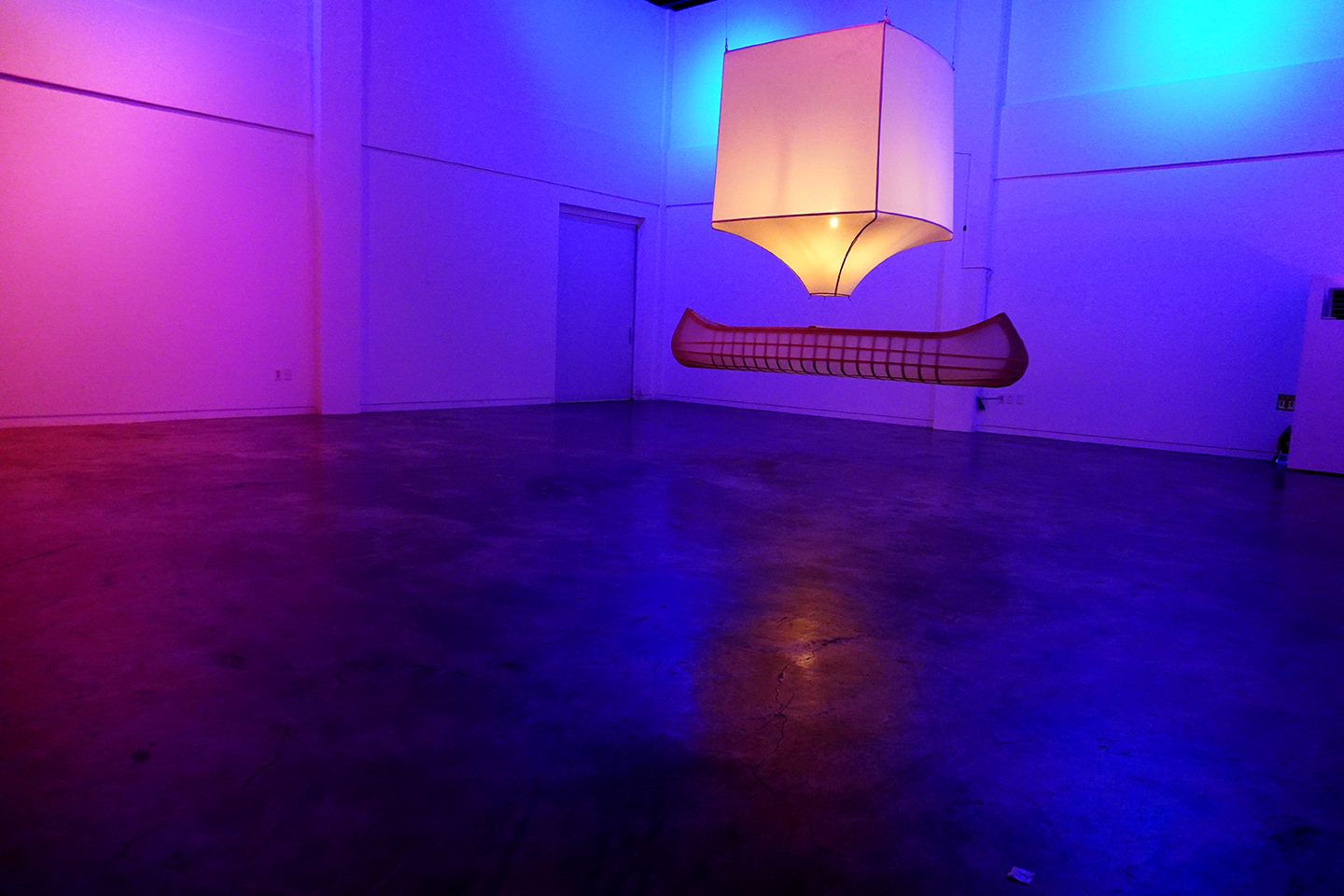
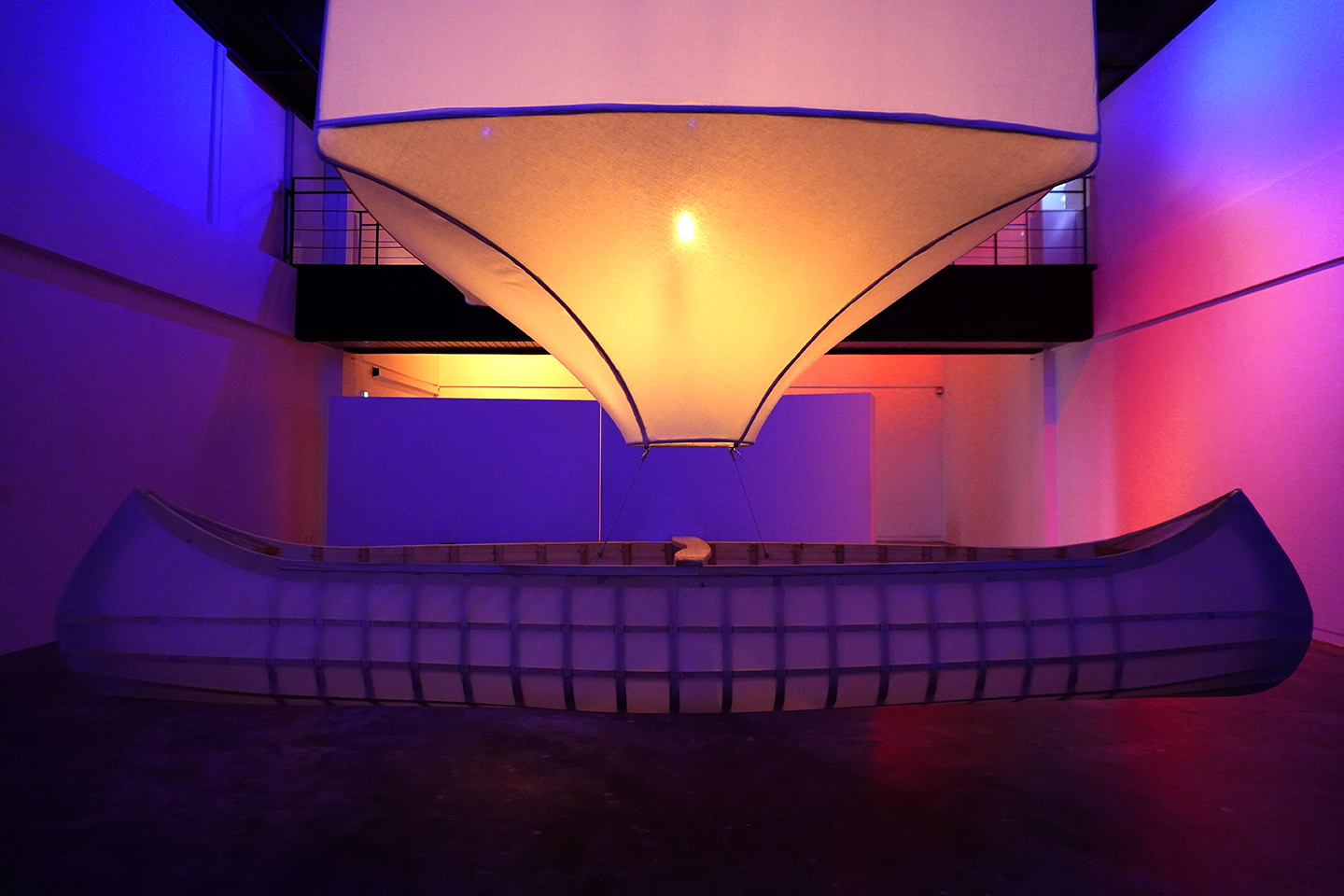
DMDLÄ : A Voyage into Life
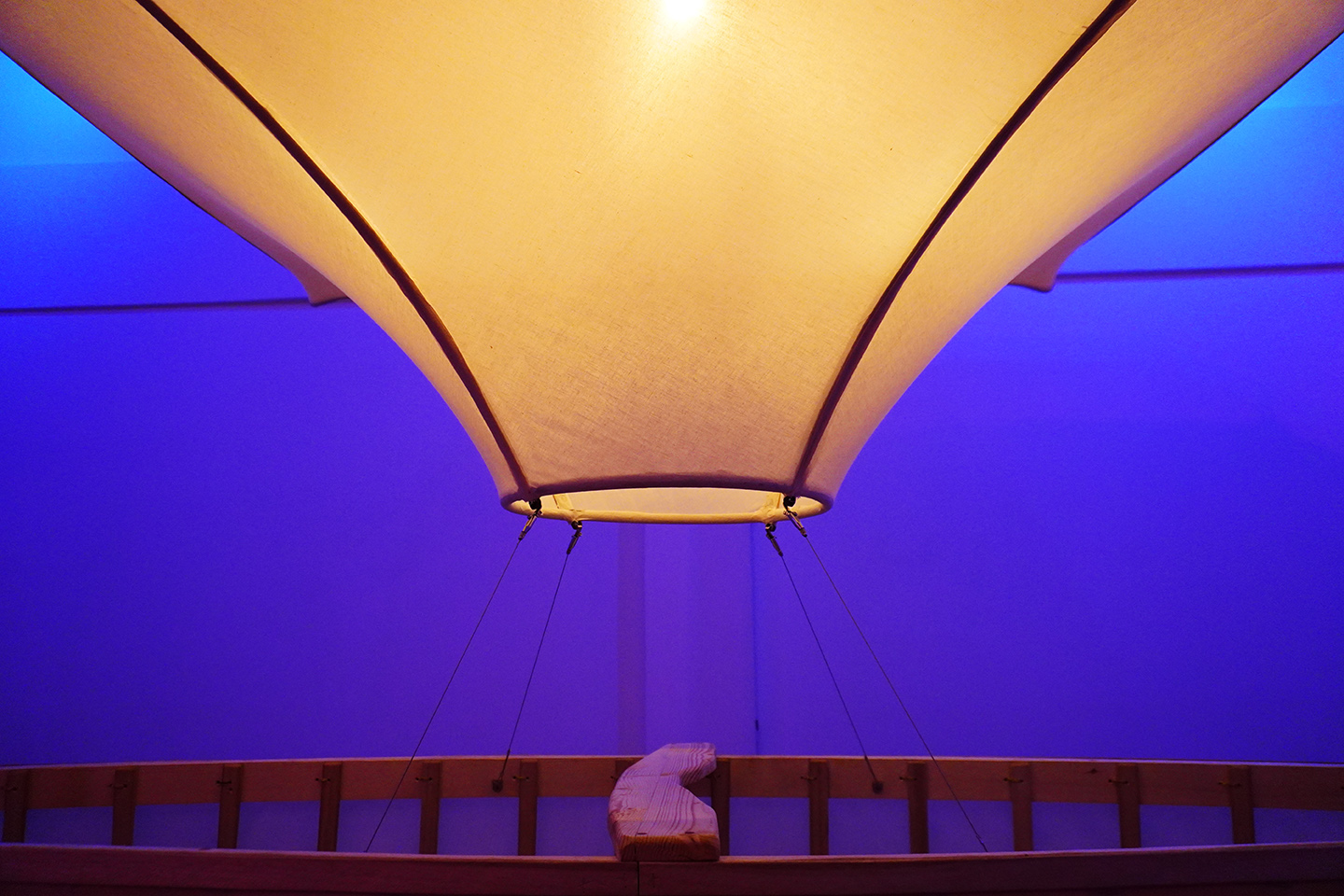
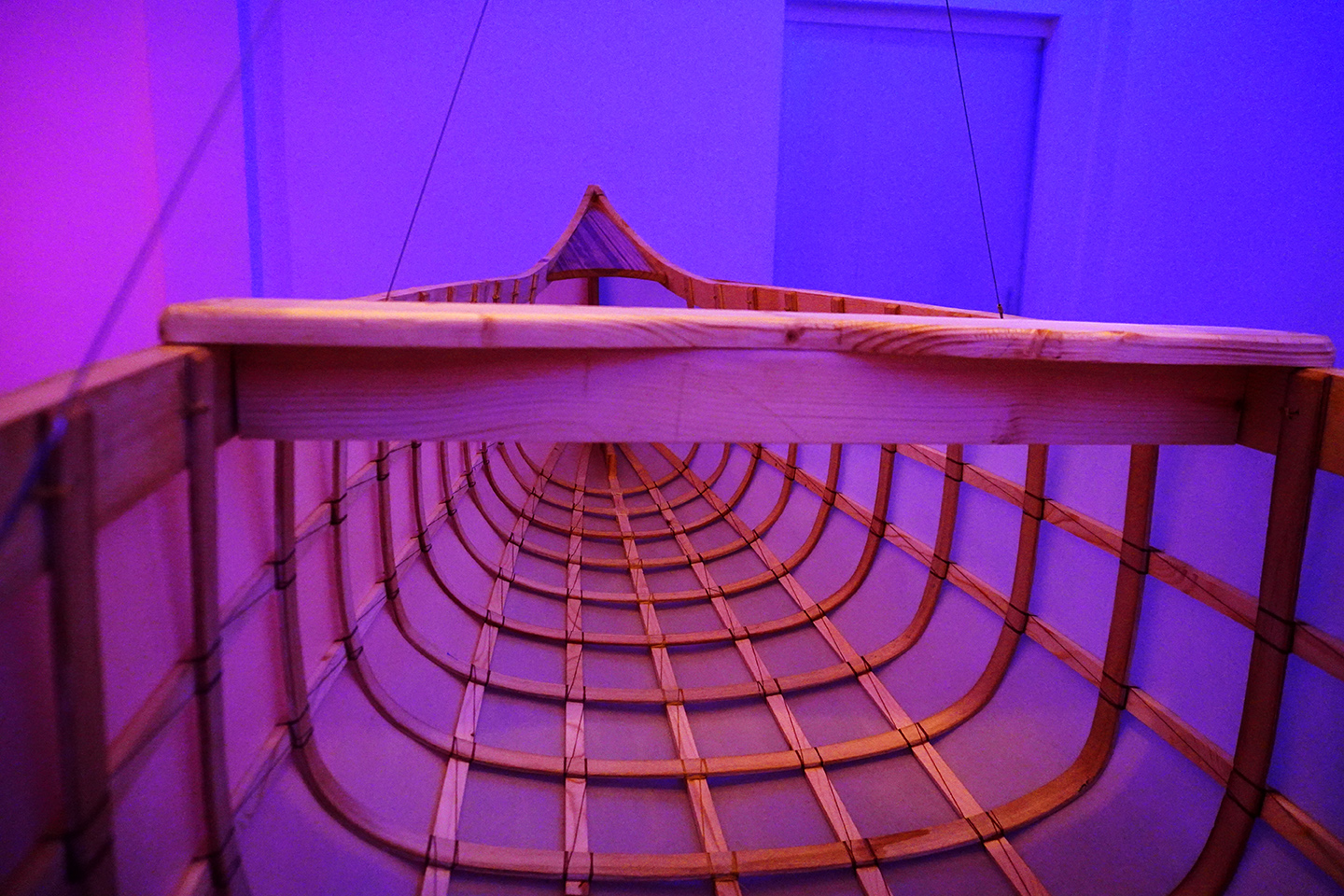
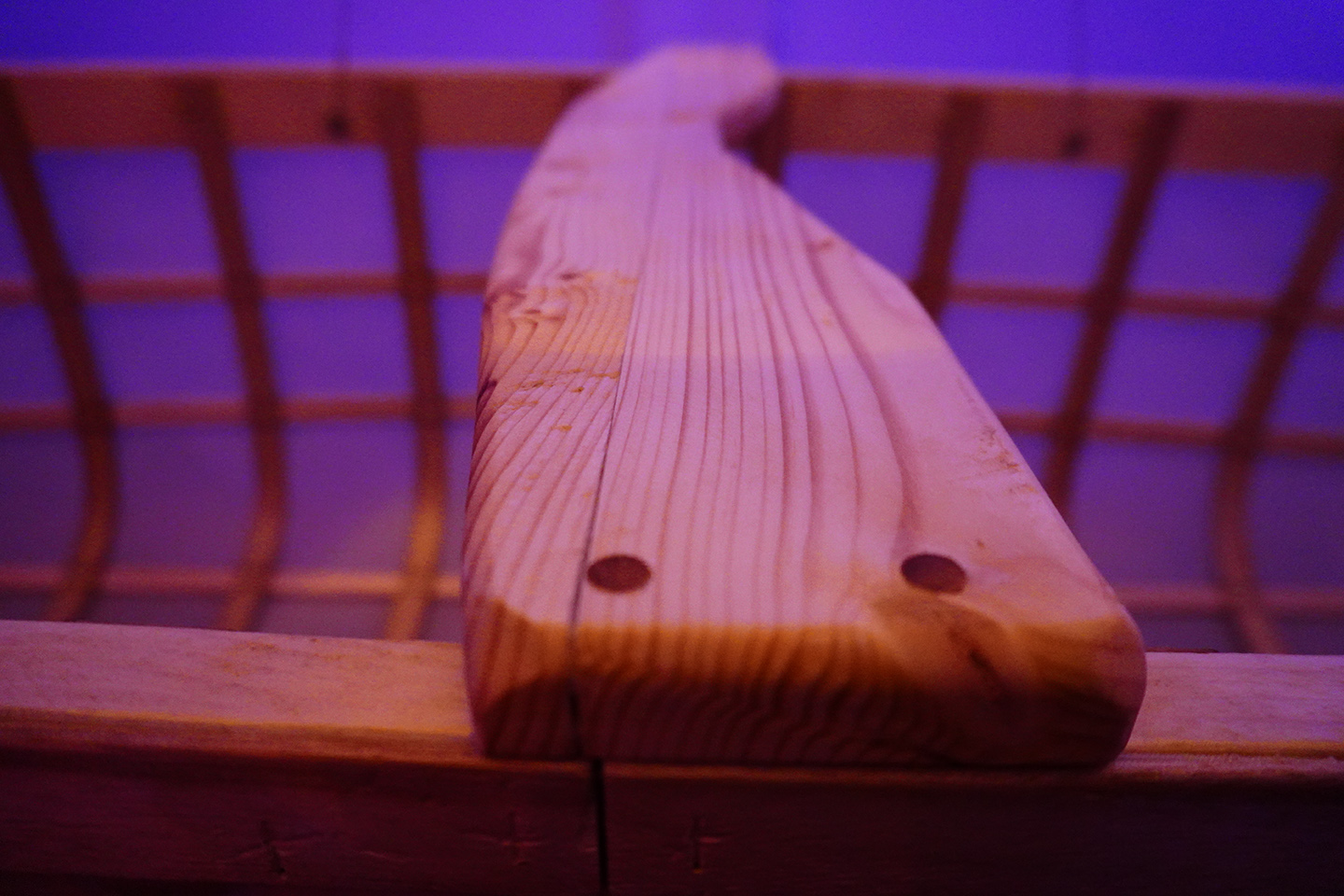
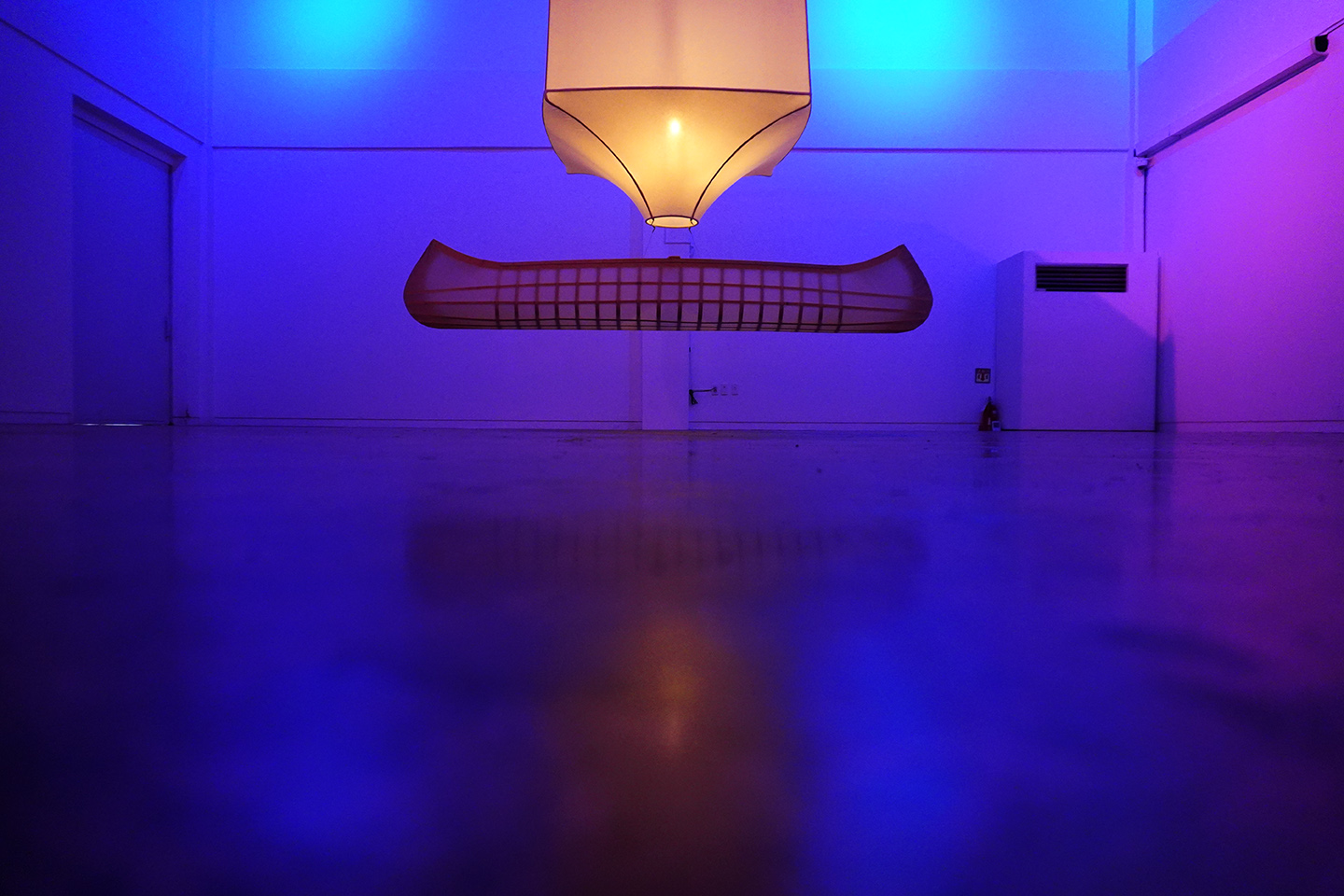
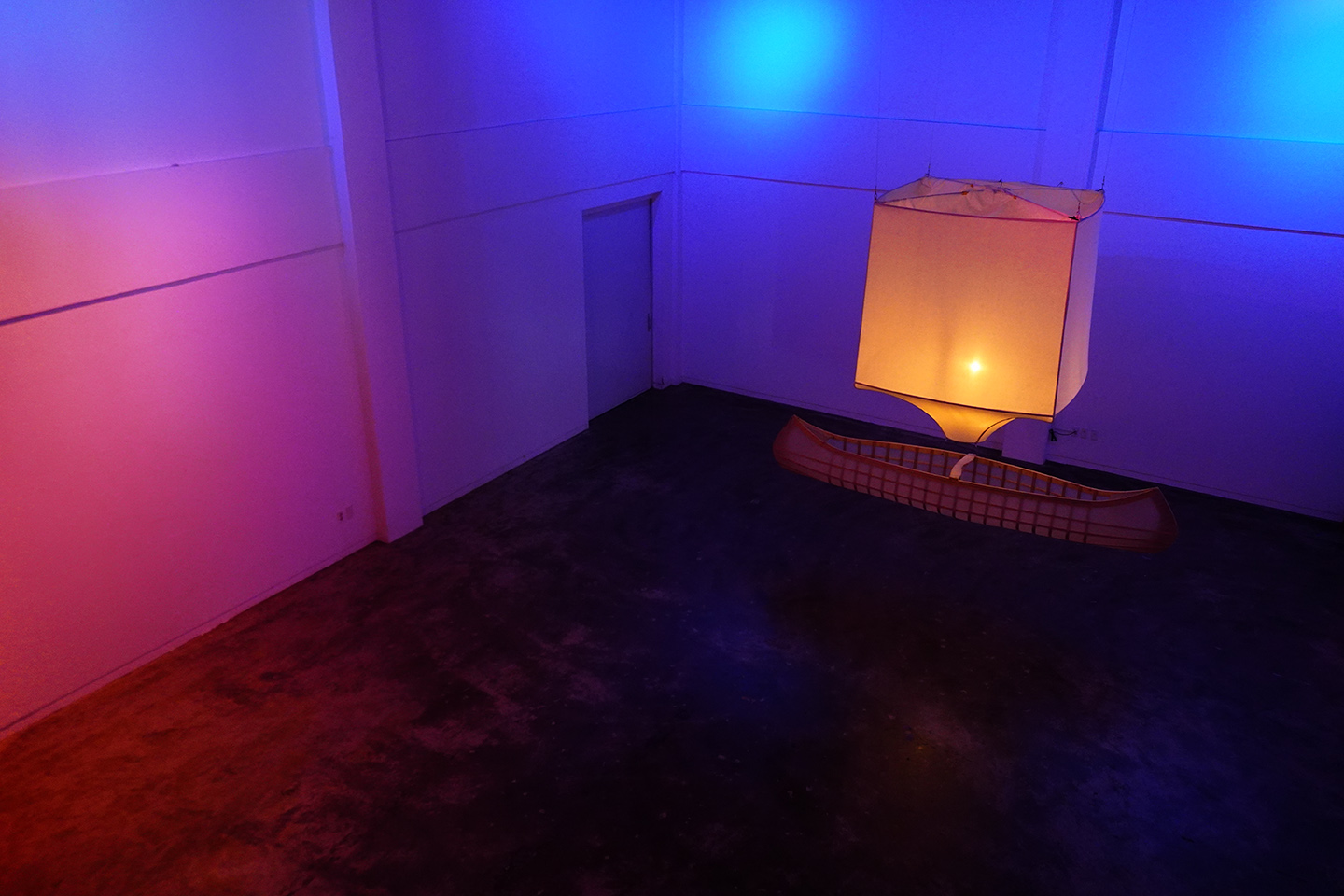
wood, cotton fabric, steel pipe, waxed thread, epoxy, wood oil, stage lights
variable dimension
2025 Hongti Art Center, Busan, Korea
variable dimension
2025 Hongti Art Center, Busan, Korea
오동나무, 목재, 광목천, 한지, 왁스실, 에폭시, 목재용 방수 오일, 무대조명 외 혼합매체
가변 크기
2025
홍티아트센터, 부산, 한국

<DMDLÄ : A Voyage into Life>, 2025
Hongti Art Centre
supported by Busan Cultural Foundation
assistant June
Hongti Art Centre
supported by Busan Cultural Foundation
assistant June
<DMDLÄ : 삶으로의 항해>, 2025
홍티아트센터
부산문화재단 지원
설치조수 준
홍티아트센터
부산문화재단 지원
설치조수 준
The sea never ceases.
Its waves drift and return,
forever breaking,
forever dissolving into the quiet vastness.
We reach toward them, yet they recede; the nearer we come,
the farther they seem to move away.
These waves, elusive and radiant, mirror our own longing our endless desire for a life that feels whole, that shimmers just beyond our grasp.
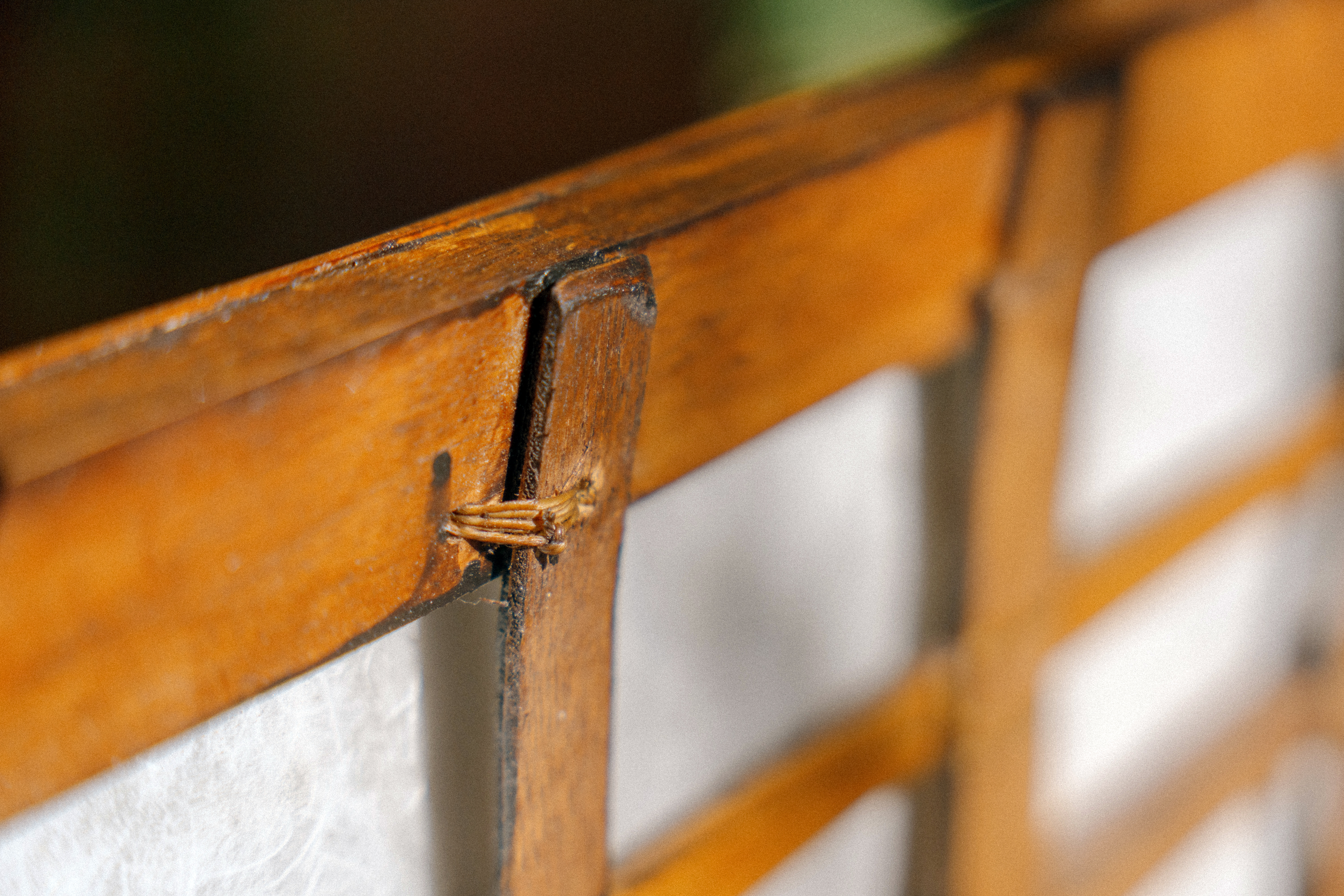
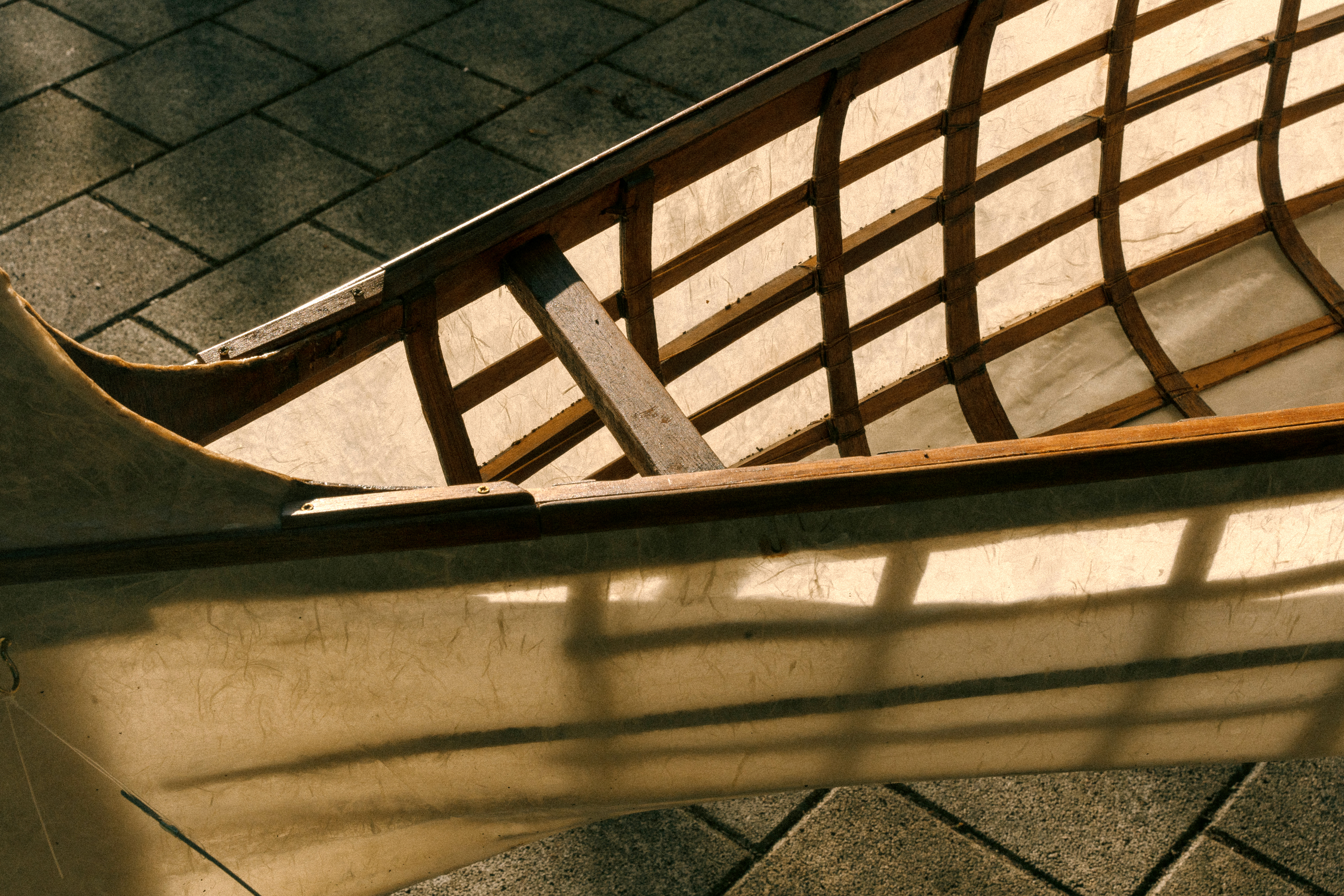
The work <DMDLÄ: Voyage into Life> is a meditation on that inward voyage — the ceaseless crossing toward a distant horizon. The canoe, crafted by hand in the traditional skin-on-frame technique, bears a lantern that sways like a fragile promise of light. Together, they speak of endurance, of patience, of the quiet labor that transformation demands.
The title borrows from Rainer Maria Rilke’s words, “Du mußt dein Leben ändern” — You must change your life. It is a whisper, both tender and insistent, urging us toward the possibility that the voyage itself is what alters us.
For the sea does not rest. In its unending rhythm, we, too, learn to breathe anew — to become, again and again, something other than what we were.
Its waves drift and return,
forever breaking,
forever dissolving into the quiet vastness.
We reach toward them, yet they recede; the nearer we come,
the farther they seem to move away.
These waves, elusive and radiant, mirror our own longing our endless desire for a life that feels whole, that shimmers just beyond our grasp.
The work <DMDLÄ: Voyage into Life> is a meditation on that inward voyage — the ceaseless crossing toward a distant horizon. The canoe, crafted by hand in the traditional skin-on-frame technique, bears a lantern that sways like a fragile promise of light. Together, they speak of endurance, of patience, of the quiet labor that transformation demands.
The title borrows from Rainer Maria Rilke’s words, “Du mußt dein Leben ändern” — You must change your life. It is a whisper, both tender and insistent, urging us toward the possibility that the voyage itself is what alters us.
For the sea does not rest. In its unending rhythm, we, too, learn to breathe anew — to become, again and again, something other than what we were.
바다 위의 스치듯 밀려오는 파도는
끊임없이 부서지고 사라진다.
손을 뻗어도 닿지 않고,
다가가려 할수록 더 멀어지는 듯한 파도는
행복한 인생을 향한 우리의 끝없는 갈망과 닮아 있다.
닿을 수 없기에 더 절실하고, 멈추지 않기에 강인한.
이번 전시에 소개되는 작품 <DMDLÄ: 삶으로의 항해> 는 그 파도를 타고 먼 바다로 나아가고자 하는 우리의 내적 항해를 은유한다. 전통적인 스킨온프레임 기법으로 제작된 카누와 그 위에 매달린 풍등은 삶을 변화시키기 위해 필요한 끊임없는 노력과 인내의 시간을 품은 채, 우리를 ‘아직 도달하지 못한 세계’로 안내한다.
제목 <DMDLÄ: 삶으로의 항해>은 시인 라이너 마리아 릴케의 편지글 중“Du Mußt Dein Leben Ändern : 당신은 당신의 인생을 바꿔야 한다.”라는 구절을 따온 것으로, 변화를 향한 고요하고 내면적인 호소이자, 동시에 이 항해 자체가 삶을 변화시키는 힘임을 드러낸다.
끊임없이 부서지고 사라진다.
손을 뻗어도 닿지 않고,
다가가려 할수록 더 멀어지는 듯한 파도는
행복한 인생을 향한 우리의 끝없는 갈망과 닮아 있다.
닿을 수 없기에 더 절실하고, 멈추지 않기에 강인한.
이번 전시에 소개되는 작품 <DMDLÄ: 삶으로의 항해> 는 그 파도를 타고 먼 바다로 나아가고자 하는 우리의 내적 항해를 은유한다. 전통적인 스킨온프레임 기법으로 제작된 카누와 그 위에 매달린 풍등은 삶을 변화시키기 위해 필요한 끊임없는 노력과 인내의 시간을 품은 채, 우리를 ‘아직 도달하지 못한 세계’로 안내한다.
제목 <DMDLÄ: 삶으로의 항해>은 시인 라이너 마리아 릴케의 편지글 중“Du Mußt Dein Leben Ändern : 당신은 당신의 인생을 바꿔야 한다.”라는 구절을 따온 것으로, 변화를 향한 고요하고 내면적인 호소이자, 동시에 이 항해 자체가 삶을 변화시키는 힘임을 드러낸다.
DMDLÄ : A Voyage into Life
wood, cotton fabric, cloud dragon paper, waxed thread, epoxy, wood oil, LED
400 x 350 x 165 cm (HxWxD)
2025 Shuei Yuan Ding Park, Taipei, Taiwan
400 x 350 x 165 cm (HxWxD)
2025 Shuei Yuan Ding Park, Taipei, Taiwan
목재, 면 천, 한지, 왁스실, 에폭시, 목재용 방수 오일, LED 외 혼합매체
400 x 350 x 165 cm (HxWxD)
2025
Shuei Yuan Ding 공원, 타이베이, 대만



<DMDLÄ : A Voyage into Life>, 2025
Southspark Fest, Taipei, Taiwan
supported by Taipei Cultural Foundation
assistant Suwei Lin
photos Arne Bürttner
Southspark Fest, Taipei, Taiwan
supported by Taipei Cultural Foundation
assistant Suwei Lin
photos Arne Bürttner
<DMDLÄ : 삶으로의 항해>, 2025
Southspark Fest, 타이베이, 대만
타이베이 문화재단 지원
설치조수 린 수웨이
사진 아르네
Southspark Fest, 타이베이, 대만
타이베이 문화재단 지원
설치조수 린 수웨이
사진 아르네
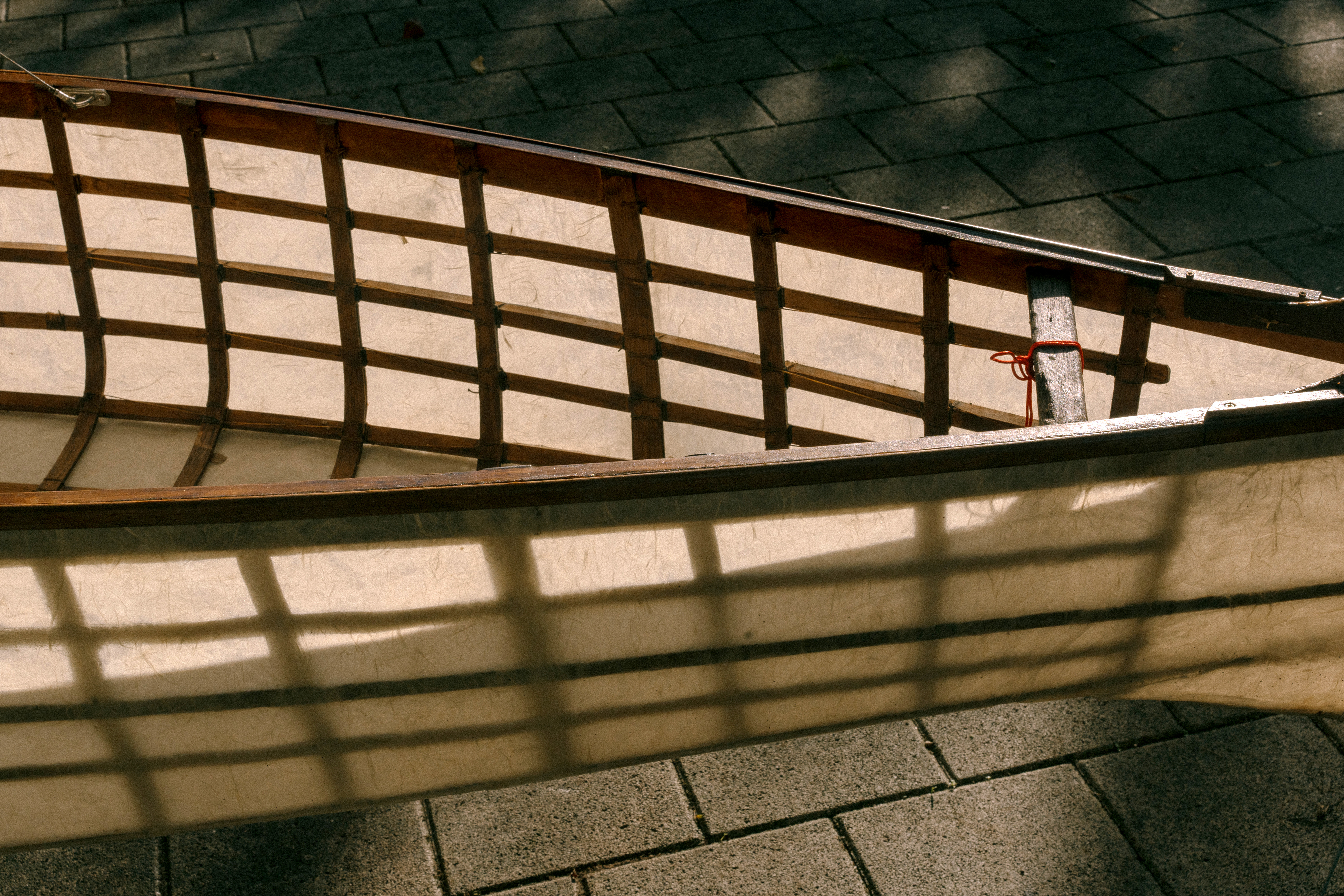
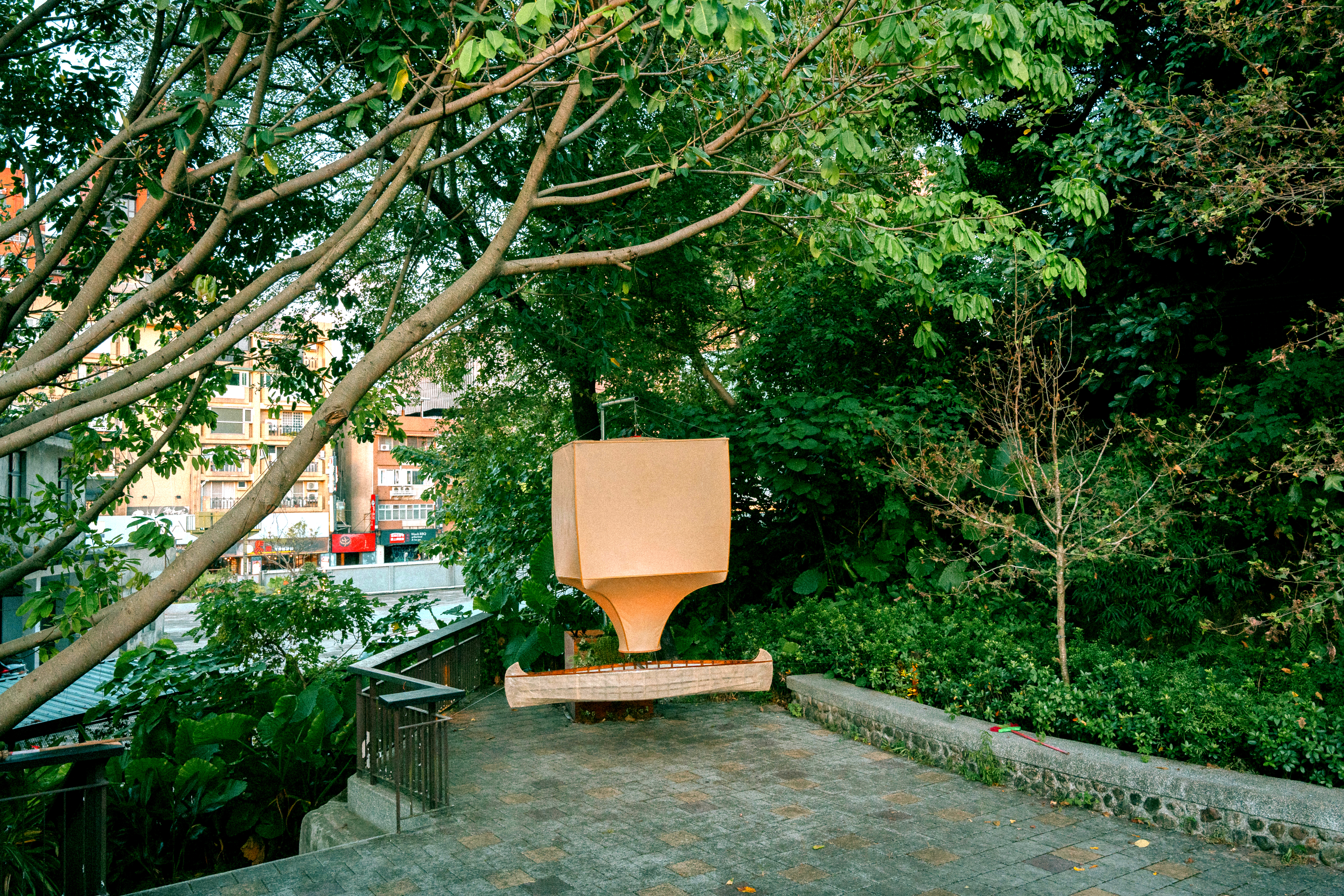
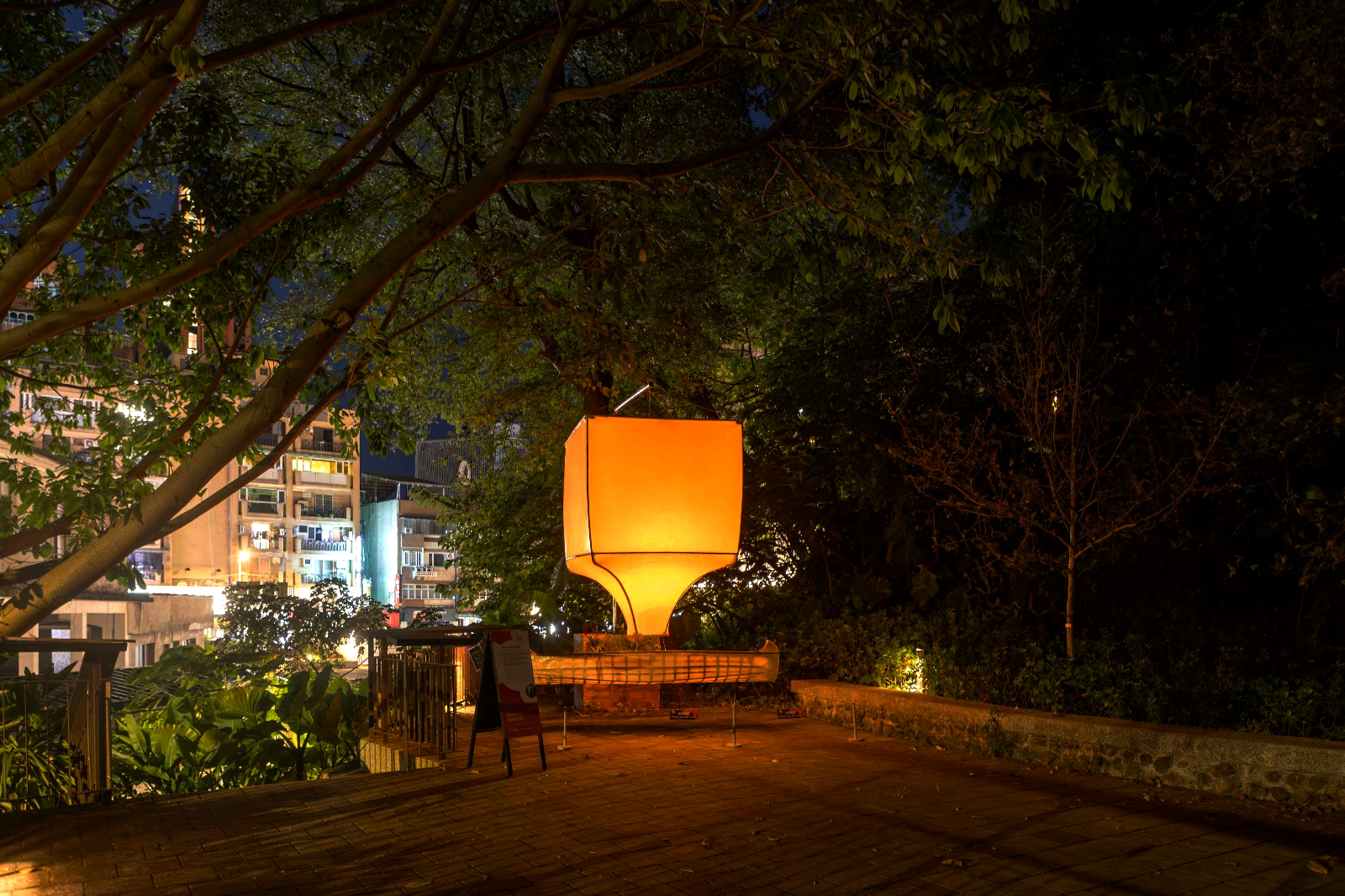
Public art holds the power to transform place into experience—inviting reflection, memory, and collective imagination. <DMDLÄ : A Voyage into Life>, which is a site-responsive installation embraces this potential . At the heart of the work is a hand-built canoe, constructed using the skin-on-frame technique. Its structure, inspired by the delicate lattice patterns of Korean traditional window frames, embodies a lifestyle attuned to the rhythmsof nature and echoes the layered histories of Taipei, where rivers once played vital roles in daily life, commerce, and spiritual continuity.
Anchored near the edge of the city’s cultural district, the canoe appears to float mid-air, tethered to a large, softly expanding balloon evocative of a sky lantern. The form breathes with the city, offering a moment of stillness amid Taipei’s dense urban texture. More than an object to behold, the work becomes a threshold: a portal into reverie, a suspended moment between time and memory.
In this way, <DMDLÄ : A Voyage into Life> becomes both destination and journey. It invites audiences to wander, wonder, and participate in the slow unfolding of a city's stories—ones not always visible on the surface, but felt in its pulse, its rituals, and its acts of quiet remembering.
* The title of the work, <DMDLÄ>, is the initials of a verse “Du Mußt Dein Leben Ändern: You Must Change Your Life”from Austrian poet Rainer Maria Rilke's poem.
Anchored near the edge of the city’s cultural district, the canoe appears to float mid-air, tethered to a large, softly expanding balloon evocative of a sky lantern. The form breathes with the city, offering a moment of stillness amid Taipei’s dense urban texture. More than an object to behold, the work becomes a threshold: a portal into reverie, a suspended moment between time and memory.
In this way, <DMDLÄ : A Voyage into Life> becomes both destination and journey. It invites audiences to wander, wonder, and participate in the slow unfolding of a city's stories—ones not always visible on the surface, but felt in its pulse, its rituals, and its acts of quiet remembering.
* The title of the work, <DMDLÄ>, is the initials of a verse “Du Mußt Dein Leben Ändern: You Must Change Your Life”from Austrian poet Rainer Maria Rilke's poem.
공공미술은 장소를 경험으로 변모시키는 힘을 지니며, 성찰과 기억, 그리고 집단적 상상을 불러일으킨다. **〈DMDLÄ : 삶으로의 항해〉**는 이러한 가능성을 포용하는 장소특정적 설치작업이다. 작품의 중심에는 스킨온프레임(skin-on-frame) 기법으로 직접 제작한 카누가 있다. 이 구조는 한국 전통 창호의 섬세한 격자무늬에서 영감을 얻어 자연의 리듬과 조화를 이루는 삶의 방식을 담아내며, 한때 일상과 상업, 영적 연속성 속에서 중요한 역할을 했던 강의 역사적 층위를 간직한 타이베이의 기억을 반영한다.
도시 문화 지구의 가장자리에 닻을 내린 카누는 마치 허공에 떠 있는 듯 보이며, 하늘로 날려 보내는 등(天燈, sky lantern)을 연상시키는 부드럽게 팽창하는 커다란 풍선에 매달려 있다. 이 형상은 도시와 함께 호흡하며, 밀도 높은 타이베이의 도시 조직 속에서 잠시 머무는 고요의 순간을 제공한다. 단순히 감상되는 오브제를 넘어, 이 작업은 하나의 문턱이자 통로가 되어 몽상으로 들어가는 길, 시간과 기억 사이에 매달린 순간으로 관객을 이끈다.
이와 같이, **〈DMDLÄ : 삶으로의 항해〉**는 동시에 목적지이자 여정이 된다. 관객을 도시의 이야기를 더듬고, 경이로움을 느끼며, 천천히 펼쳐지는 서사 속에 참여하도록 초대한다. 이 이야기는 표면에서 항상 보이지는 않지만, 도시의 맥박과 의례, 그리고 조용한 기억의 행위 속에서 감각될 수 있다.
도시 문화 지구의 가장자리에 닻을 내린 카누는 마치 허공에 떠 있는 듯 보이며, 하늘로 날려 보내는 등(天燈, sky lantern)을 연상시키는 부드럽게 팽창하는 커다란 풍선에 매달려 있다. 이 형상은 도시와 함께 호흡하며, 밀도 높은 타이베이의 도시 조직 속에서 잠시 머무는 고요의 순간을 제공한다. 단순히 감상되는 오브제를 넘어, 이 작업은 하나의 문턱이자 통로가 되어 몽상으로 들어가는 길, 시간과 기억 사이에 매달린 순간으로 관객을 이끈다.
이와 같이, **〈DMDLÄ : 삶으로의 항해〉**는 동시에 목적지이자 여정이 된다. 관객을 도시의 이야기를 더듬고, 경이로움을 느끼며, 천천히 펼쳐지는 서사 속에 참여하도록 초대한다. 이 이야기는 표면에서 항상 보이지는 않지만, 도시의 맥박과 의례, 그리고 조용한 기억의 행위 속에서 감각될 수 있다.
- 작품의 제목 **〈DMDLÄ〉**는 오스트리아 시인 라이너 마리아 릴케의 시 속 구절 “Du Mußt Dein Leben Ändern: 너는 네 삶을 바꾸어야 한다” 의 머리글자를 딴 것이다.
A City of Sadness
wood, steel pipes, LEDs, bricks, cables, electronic components
235 x 215 x 115 cm (HxWxD)
2024 Treasure Hill Artist Village, Taipei, Taiwan
목재, 쇠파이프, LED네온, 벽돌, 전기부품
235 x 215 x 115 cm
2024
보장암 예술마을, 타이베이, 대만




<A City of Sadness>, 2024 Busan Cultural Foundation
& Taipei Cultural Foundation
assistant Suwei Lin
photos Yang, Wei-Chung
assistant Suwei Lin
photos Yang, Wei-Chung
<비정성시>, 2024
부산문화재단 및 타이베이 문화재단 지원
설치조수 린 수웨이
사진 양 웨이청
부산문화재단 및 타이베이 문화재단 지원
설치조수 린 수웨이
사진 양 웨이청
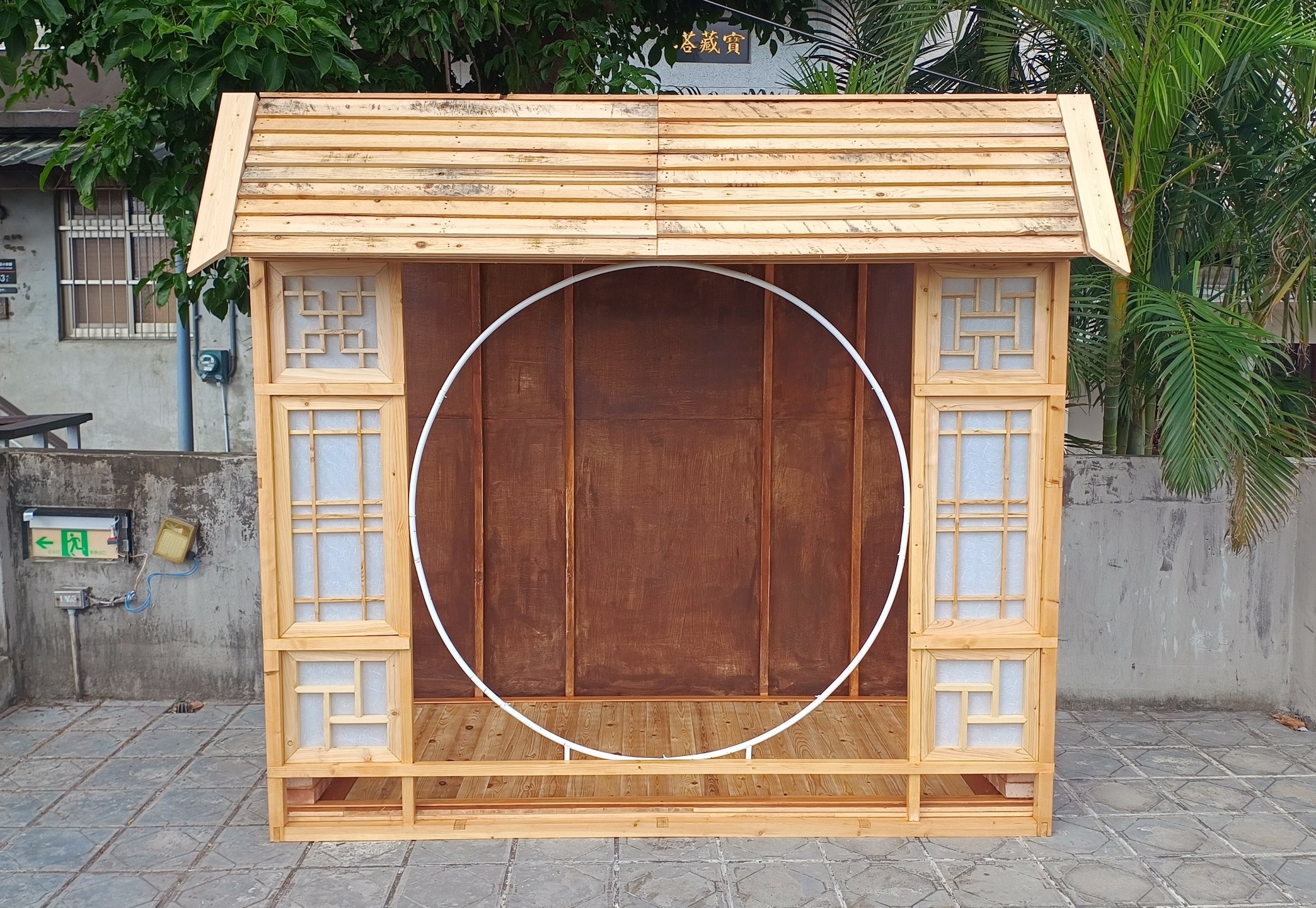
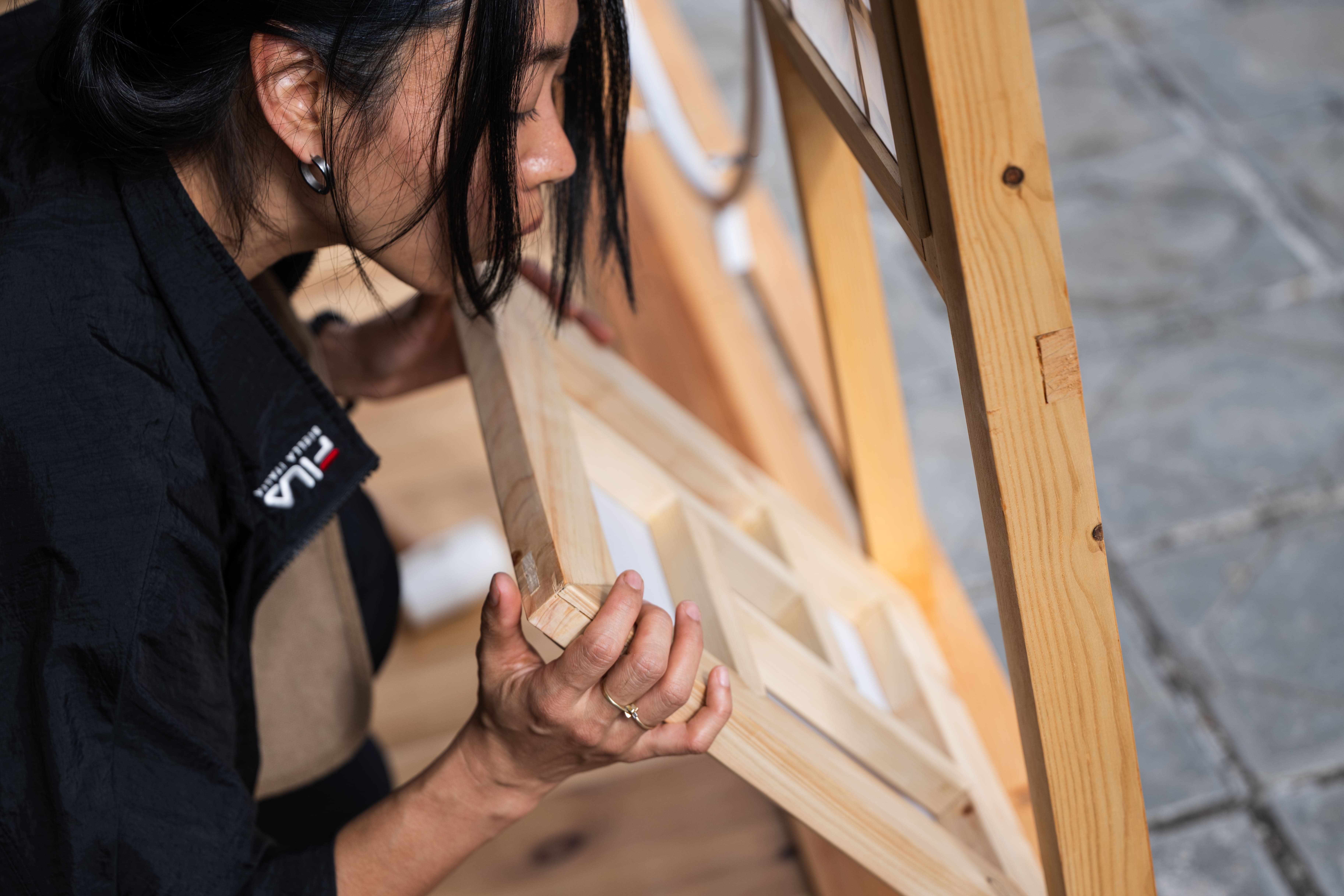
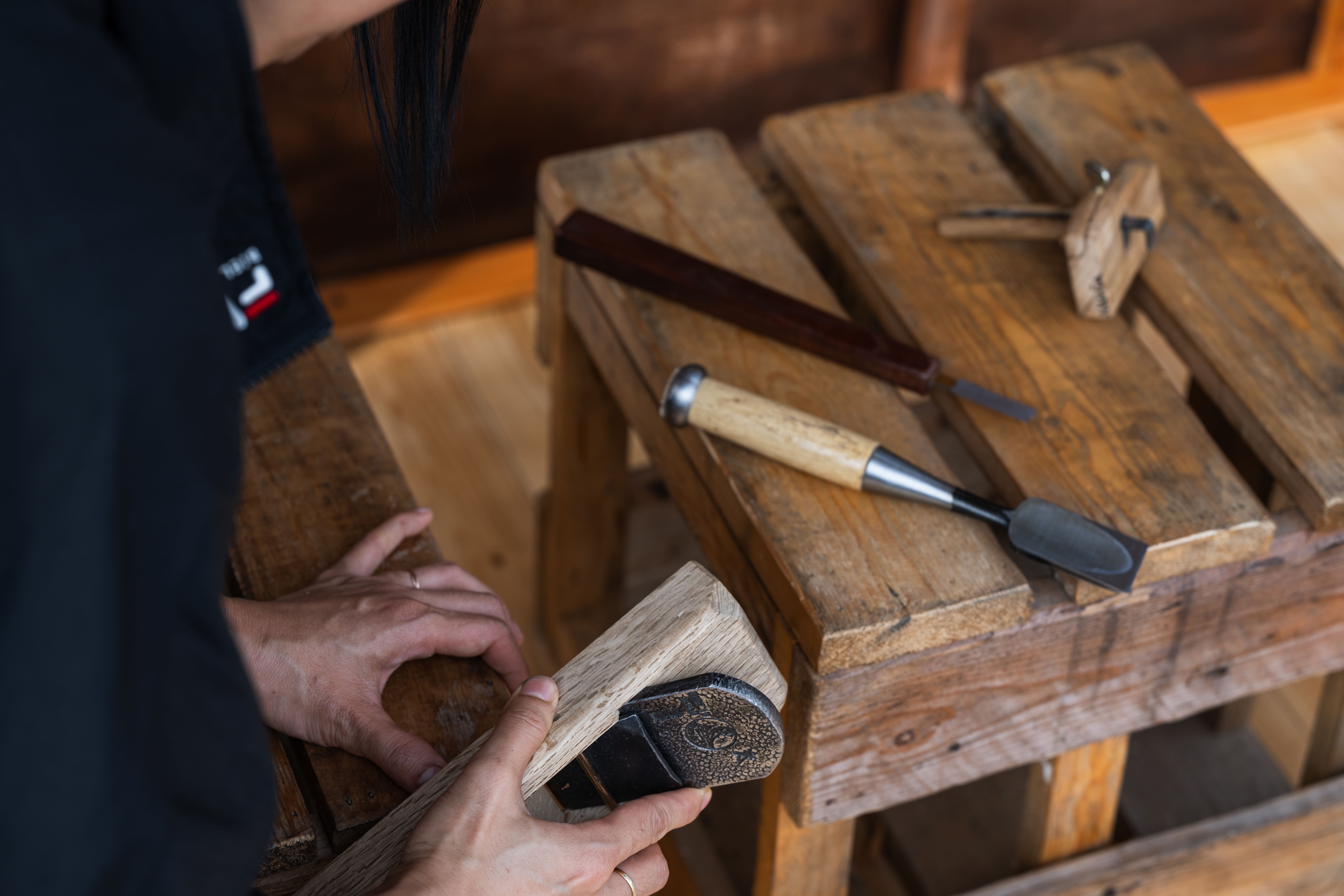
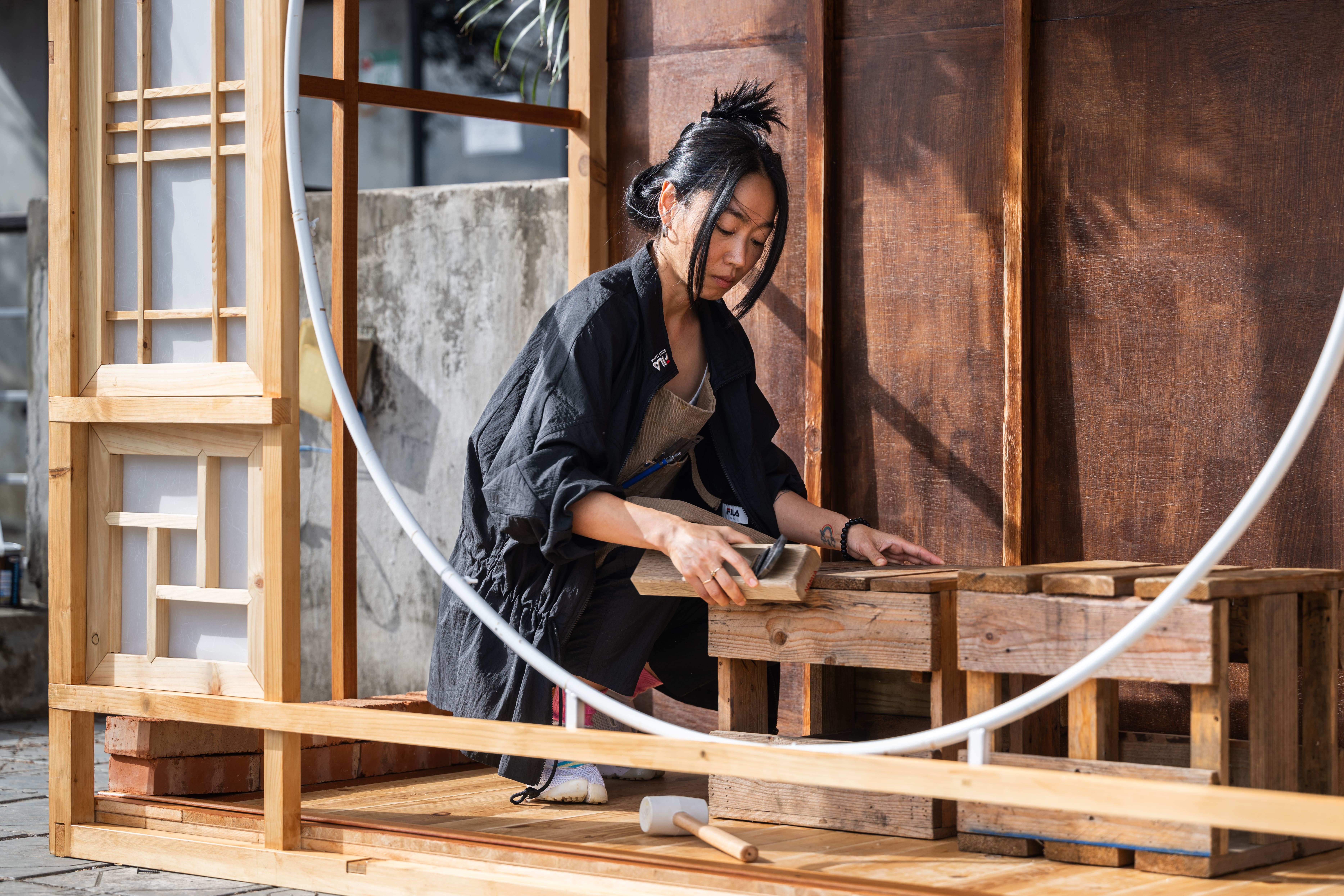
<A City of Sadness>, inspired by Taipei's urban poor and their histories, integrates traditional Korean construction techniques to repair and restore neglected spaces. This not only honors the architecture of past inhabitants but also symbolizes healing and memory restoration within a narrative framework enriched by speculative fiction.
In a world where many marginalized communities struggle to secure basic living conditions, the exploration of unauthorized structures serves as a poignant commentary on contemporary challenges, echoing issues faced still in the 21st century, such as urban poor, eviction, demolition that often threat subsistence of the inhabitants.
By transforming lost aspects of society into meaningful artworks, <A City of Sadness> invites viewers to engage with their histories and surroundings.
In a world where many marginalized communities struggle to secure basic living conditions, the exploration of unauthorized structures serves as a poignant commentary on contemporary challenges, echoing issues faced still in the 21st century, such as urban poor, eviction, demolition that often threat subsistence of the inhabitants.
By transforming lost aspects of society into meaningful artworks, <A City of Sadness> invites viewers to engage with their histories and surroundings.
타이베이의 도시 빈민과 그들의 역사에서 영감을 받은 <비정성시>는 한국의 전통 건축 기법을 접목하여 방치된 공간을 수리하고 복원한다. 이는 과거 이 보장암 마을 거주민들의 건축물을 기리는 것뿐만 아니라, 추측적 허구로 풍성해진 서사적 틀 안에서 치유와 기억의 회복을 상징한다.
많은 소외된 공동체가 기본적인 생활 조건을 확보하기 위해 고군분투하는 세상에서, 무허가 건축물에 대한 탐구는 도시 빈민, 퇴거, 철거와 같이 21세기에도 여전히 주민들의 생계를 위협하는 문제들을 반영하며 동시대적 과제에 대한 통렬한 논평을 제시한다.
<비정성시>는 사회의 잃어버린 단면들을 의미 있는 예술 작품으로 재해석하여 관람객들이 자신의 역사와 주변 환경에 깊이 관여하도록 공간 속으로 초대한다.
많은 소외된 공동체가 기본적인 생활 조건을 확보하기 위해 고군분투하는 세상에서, 무허가 건축물에 대한 탐구는 도시 빈민, 퇴거, 철거와 같이 21세기에도 여전히 주민들의 생계를 위협하는 문제들을 반영하며 동시대적 과제에 대한 통렬한 논평을 제시한다.
<비정성시>는 사회의 잃어버린 단면들을 의미 있는 예술 작품으로 재해석하여 관람객들이 자신의 역사와 주변 환경에 깊이 관여하도록 공간 속으로 초대한다.
Passepartout Duo x Namia Leigh
Sound performance & Installation collaboration
Sister Outsider in Busan
steel pipes, LEDs, stage lights, agar agar, spilurina, water tanks, UV lamps, cables, electronic components
373 x 550 x 295 cm
2023 Hello Artist Gallery, Busan, Korea
쇠파이프, LED 조명, 무대용 조명, 수조, 한천가루, 스피루리나, 살균램프, 케이블, 전자 부품
373 x 550 x 295 cm
2023
헬로 아티스트 갤러리, 부산, 한국


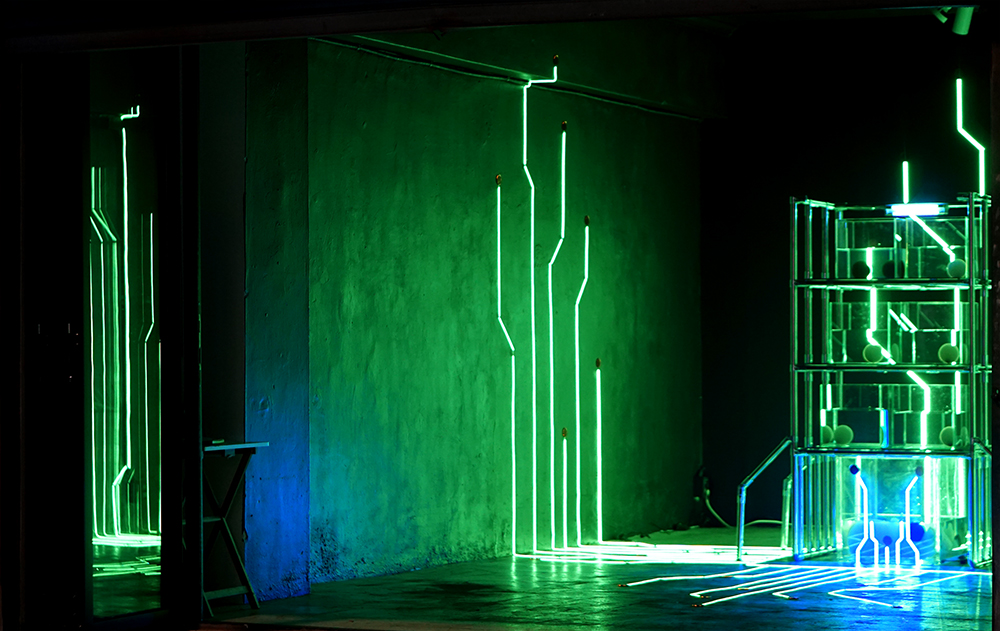

<Sister Outsider in Busna>, 2023
Busan Cultural Foundation
assistant Jiwon Kim
Busan Cultural Foundation
assistant Jiwon Kim
<시스터 아웃사이더 인 부산>, 2023
부산광역시 & 부산문화재단 지원
설치조수 : 김지원
부산광역시 & 부산문화재단 지원
설치조수 : 김지원
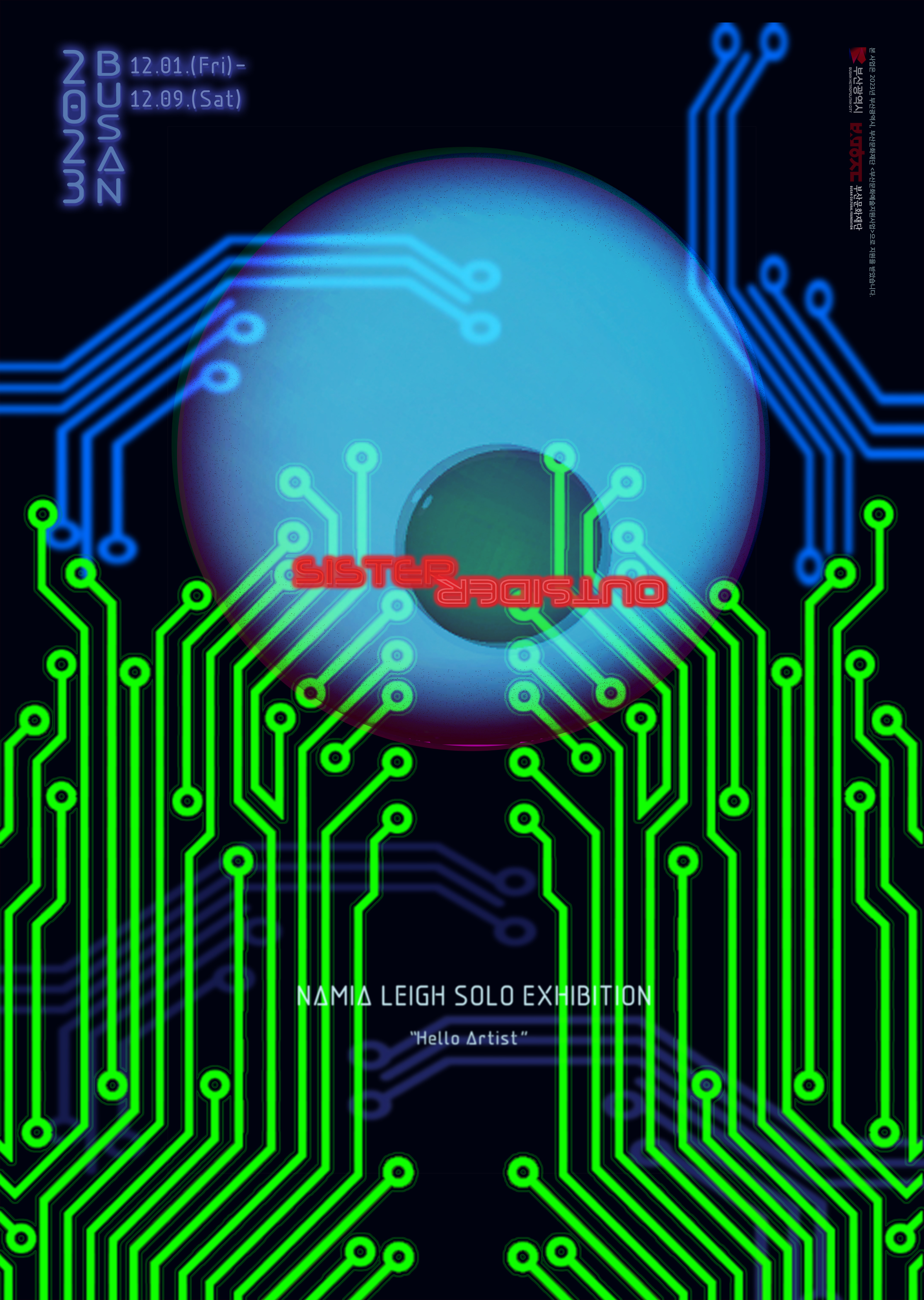
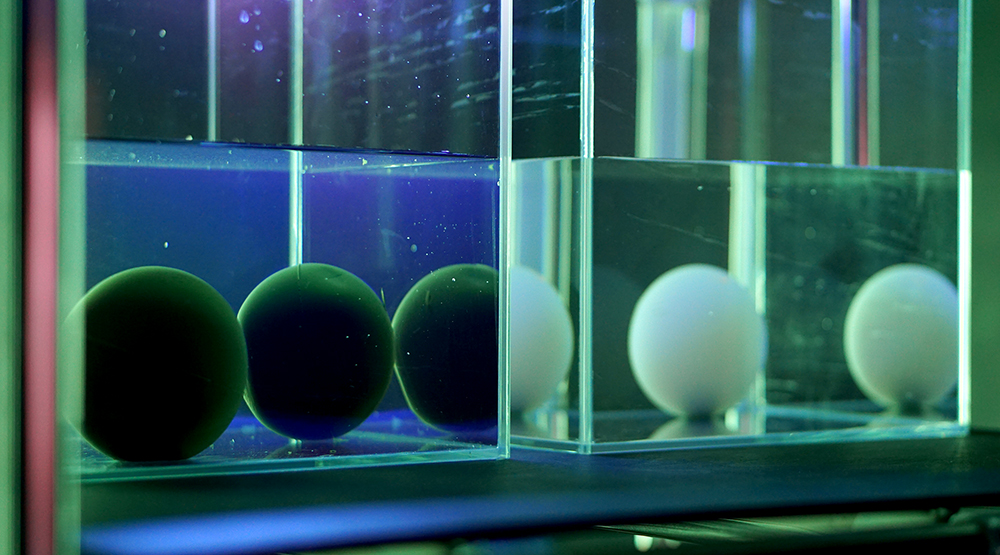
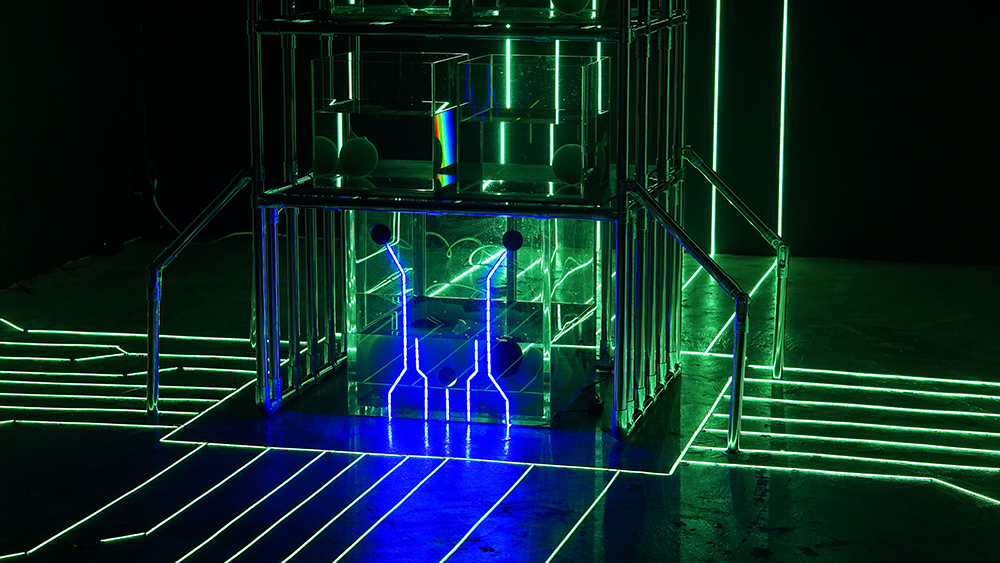
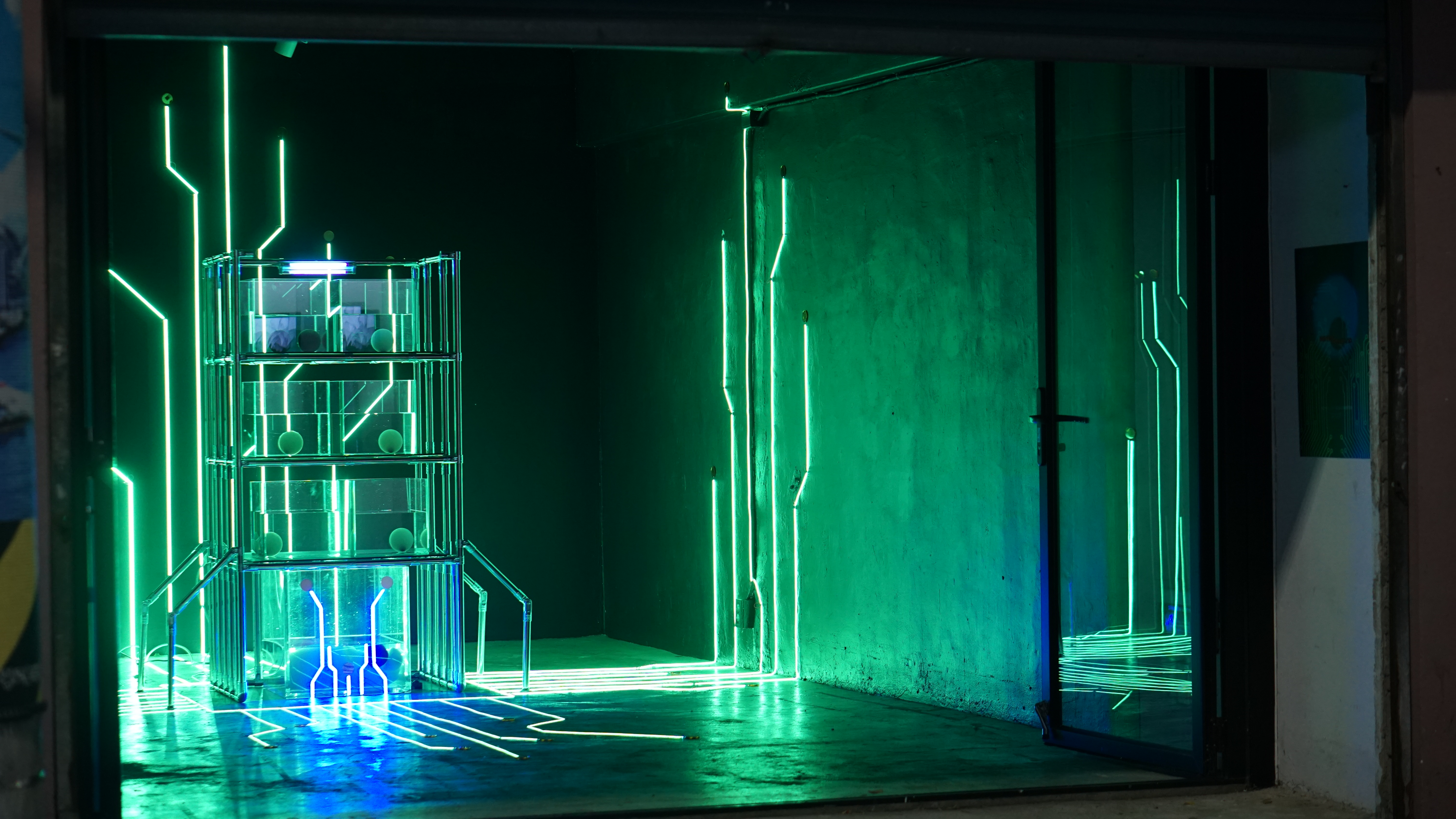
Sister Outsider carries out a story that begins with the discovery of "something" in the sea off the coast of Busan during a deep-sea exploration after radioactive material leaked into the sea. This 'something' is codenamed "Sister Outsider" and will be revealed in a solo exhibition in Busan on December 1, 2023. Shaped like an egg covered in sticky slime, it is kept in a steel cage with a sterilization lamp and displayed in front of the public, hatching or being destroyed. The eggs, which are actually made of agar agar and spirulina, will be exposed to a laboratory environment for the duration of the exhibition, showing in real time the changes they undergo.
No matter what kind of life, when placed in a laboratory environment, it is no longer able to live as a natural life, but becomes artificial. The rapid growth of science and technology has given legitimacy to the act of experimentation, which has led to the death and rebirth of countless living beings. What will a world with only humanity look like at the end of a world where manipulation or destruction of other living beings, including nature, is justified for the sake of 'humanity's survival' or 'sustaining life'?
No matter what kind of life, when placed in a laboratory environment, it is no longer able to live as a natural life, but becomes artificial. The rapid growth of science and technology has given legitimacy to the act of experimentation, which has led to the death and rebirth of countless living beings. What will a world with only humanity look like at the end of a world where manipulation or destruction of other living beings, including nature, is justified for the sake of 'humanity's survival' or 'sustaining life'?
시스터 아웃사이더는 방사능 물질이 바다로 유출된 이후 심해 탐사 동안 발견된 ‘무언가‘가 부산 바다에서 끌어올려지는 것으로 시작되는 사변적 이야기이다. 2023년 12월 1일에 개인전에서 선보일 이 ’무언가‘는 “시스터 아웃사이더”라는 코드명을 달고 부산에서 전시회를 통해 그 모습이 공개된다.
끈적한 점액으로 뒤덮인 알의 모양을 하고 있는 이것은 살균 램프가 달린 철장 안에 보관되어 부화될지 파괴될지의 운명의 기로에 놓인 채 사람들 앞에 전시된다. 실제로 우뭇가사리와 스피루리나 등을 재료로 만든 알은 전시기간 동안 열린 환경에 노출된 채로 나도 알 수 없는 어떤 변화를 실시간으로 보여줄 것이다.
어떠한 생명이라 할지라도 실험실 환경에 놓인 생명체는 더 이상 자연적인 생명의 과정체로 살아갈 수 없으며 인공적으로 다뤄지게 된다. 과학기술의 눈부신 성장은 실험이란 행위에 정당성을 부여했고, 그로인해 셀 수 없는 생명체들이 죽고 다시 재생된다. 소위 ‘인류세’라 칭하는 현시점에서 ‘인류의 존속’을 위해 또는 ‘생명 유지’를 위해 자연을 포함한 다른 생명체를 조작하거나 파멸시키는 것이 정당해지는 세상. 그 끝에 펼쳐질 ‘인류’만이 존재하는 세상은 어떤 모습일까?
나는 작업을 통해 과정과 붕괴, 인간과 비인간, 혼종된 무언가, 다수종의 다양성에 대한 이야기를 다루고 싶다. 따라서 나의 작업에서 필멸성과 변화의 테마는 계속된다.
끈적한 점액으로 뒤덮인 알의 모양을 하고 있는 이것은 살균 램프가 달린 철장 안에 보관되어 부화될지 파괴될지의 운명의 기로에 놓인 채 사람들 앞에 전시된다. 실제로 우뭇가사리와 스피루리나 등을 재료로 만든 알은 전시기간 동안 열린 환경에 노출된 채로 나도 알 수 없는 어떤 변화를 실시간으로 보여줄 것이다.
어떠한 생명이라 할지라도 실험실 환경에 놓인 생명체는 더 이상 자연적인 생명의 과정체로 살아갈 수 없으며 인공적으로 다뤄지게 된다. 과학기술의 눈부신 성장은 실험이란 행위에 정당성을 부여했고, 그로인해 셀 수 없는 생명체들이 죽고 다시 재생된다. 소위 ‘인류세’라 칭하는 현시점에서 ‘인류의 존속’을 위해 또는 ‘생명 유지’를 위해 자연을 포함한 다른 생명체를 조작하거나 파멸시키는 것이 정당해지는 세상. 그 끝에 펼쳐질 ‘인류’만이 존재하는 세상은 어떤 모습일까?
나는 작업을 통해 과정과 붕괴, 인간과 비인간, 혼종된 무언가, 다수종의 다양성에 대한 이야기를 다루고 싶다. 따라서 나의 작업에서 필멸성과 변화의 테마는 계속된다.
© 2026 NAMIA LEIGH x SiSTER OUTSIDER